
Inherited Gold IRA: What Beneficiaries Can Do With Inherited Coins and Bars
An inherited gold IRA is an IRA that holds physical precious metals and passes to a beneficiary when the account owner dies. The gold doesn’t become yours like gold left in a will. It stays inside an IRA, and the IRA distribution rules decide when it must come out and what taxes you owe. An IRA inheritance follows different rules from the rest of an inheritance.
This guide covers what is different when the inherited account holds coins and bars. For the general rules on beneficiary classes and the 10-year rule, see our inherited IRA rules guide. Sources are IRS Publications 590-A, 590-B, 551, 544, and 559, plus the Form 1099-R instructions.
IRAInvesting.com may earn a referral fee if you work with one of the gold IRA companies we review. That doesn’t change the IRS rules here. See our affiliate disclosure.
What is an inherited gold IRA?
It’s a gold IRA you receive as a named beneficiary. The original owner died, and the account, with the coins still in the depository, now belongs to you as beneficiary.
The IRA custodian keeps holding the precious metals. Pub 590-B warns that if the owner or the beneficiary of the IRA takes possession of the coins, they’re treated as distributed. So don’t ask the depository to ship the coins home until you’ve decided to take a distribution. Our gold IRA storage guide explains how depositories hold IRA metal.
Who inherits: the beneficiary designation
The beneficiary designation on file with the custodian generally decides who inherits the IRA, not the will. If no beneficiary is named, the IRA document usually sends the account to the estate. Our IRA beneficiary designation guide explains how forms work.
First steps: call the IRA custodian

Call the custodian, not the dealer. The custodian holds the account, the beneficiary records, and the physical possession of the coins and bars through its depository.
Have the account number, a certified death certificate, and your ID ready. The custodian will send its own claim forms.
Ask for the latest statement. It lists each coin and bar, the depository, and the account’s value.
Ask whether the original owner took the required minimum distributions for the year of death. If the owner died on or after the required beginning date and hadn’t taken it, beneficiaries generally must take that amount.
Don’t sell, ship, or move anything until you know your options. A wrong step can create a taxable distribution you can’t undo, and then the full amount counts as income in one year.
Options for a surviving spouse
A surviving spouse has the most choices. Pub 590-B lets a spouse who inherits a traditional IRA treat it as their own IRA, roll it into their own IRA, or stay a beneficiary.
Treating it as your own IRA
Treating it as your own means the IRA follows your age for RMDs, and you can add contributions or funds from another IRA. If you’re under 59½, distributions may face the 10% additional tax, which a beneficiary account avoids.
Staying a beneficiary
Staying a beneficiary can make sense for a younger surviving spouse who may need money before 59½. Married couples often weigh this choice with a CPA. Pub 590-B says a spouse is treated as choosing to make the IRA their own by contributing to it or by skipping a required distribution as beneficiary.
A sole beneficiary spouse has the widest set of options. If several people share the account, the choices narrow.
Options for non spouse beneficiaries
Non spouse beneficiaries can’t treat an inherited IRA as their own. Pub 590-A says you can’t contribute to it or roll money into or out of it. You can make a trustee-to-trustee transfer to another inherited IRA kept in the deceased owner’s name for your benefit.
The SECURE Act 10-year rule
Under the SECURE Act, most designated beneficiaries who inherit from an owner who died after 2019 must empty the account by December 31 of the year containing the 10th anniversary of the death. If the owner died in 2025, that’s December 31, 2035. Before 2020, designated beneficiaries could generally take life expectancy payments instead; that option now mostly belongs to eligible designated beneficiaries.

If the owner died on or after the required beginning date, Pub 590-B also calls for yearly RMDs based on life expectancy in the years after death. RMDs based on the longer of your life expectancy or the owner’s apply in years one through nine, and the account must still be empty by year ten. Our gold IRA RMD guide explains how yearly withdrawals work with metal.
Missing required minimum distributions can bring an IRS excise tax on top of the income owed. Check the current amount and timing with a tax professional.
If there’s no designated beneficiary
If no person is named, or the IRA agreement sends the account to the estate, Pub 590-B treats it as having no designated beneficiary. If the owner died before the required beginning date, the 5-year rule applies: the account must be empty by December 31 of the year containing the fifth anniversary of the death. A 2025 death means December 31, 2030. If the owner died on or after that date, withdrawals follow the owner’s remaining life expectancy.
Eligible designated beneficiaries
Eligible designated beneficiaries can stretch distributions over life expectancy. Pub 590-B lists a surviving spouse, the owner’s minor children, a disabled or chronically ill person, and anyone not more than 10 years younger than the owner.
For minor children, the 10-year rule starts when the child reaches the age of majority. An inheritance left to young children often involves a custodian or trust, so get legal advice.
Inherited Roth IRA
An inherited Roth IRA also has to be emptied by the end of the 5th or 10th year, as applicable. Qualified Roth distributions are generally tax free, and that benefit includes the gain on the metal. If the Roth’s five-year period hasn’t run, earnings may be taxable. See our Roth gold IRA guide.
What makes inherited precious metals different
With inherited gold, every step involves physical gold and other precious metals held in a depository, so distributions take more planning than with mutual funds or other inherited assets.
Keep in kind or sell
You have two ways to take distributions. For tax purposes, a distribution of coins counts the same as cash. You can sell the holdings inside the IRA and withdraw the proceeds, or take the coins and bars themselves.
Selling inside the IRA isn’t taxed until the cash comes out. See how to sell gold in an IRA for the sale process.
An in-kind distribution sends the coins and bars to you. The Form 1099-R instructions require the custodian to report the fair market value of property on the date of distribution, with code 4 for a payment to a beneficiary. Our in-kind distribution guide covers shipping and valuation.
Fair market value and spot price
The fair market value used for a distribution comes from the custodian’s pricing. It’s often close to the spot price, but a dealer will usually bid below spot price when you sell. That difference is a real cost, along with shipping and other costs. Ask both the custodian and the dealer how they value each product.
Dividing coins and bars among heirs
Pub 590-B lets a single IRA be split into separate accounts or shares for each beneficiary. With metal, that means dividing specific coins and bars. Ask the custodian how it splits holdings that don’t divide evenly by full value.
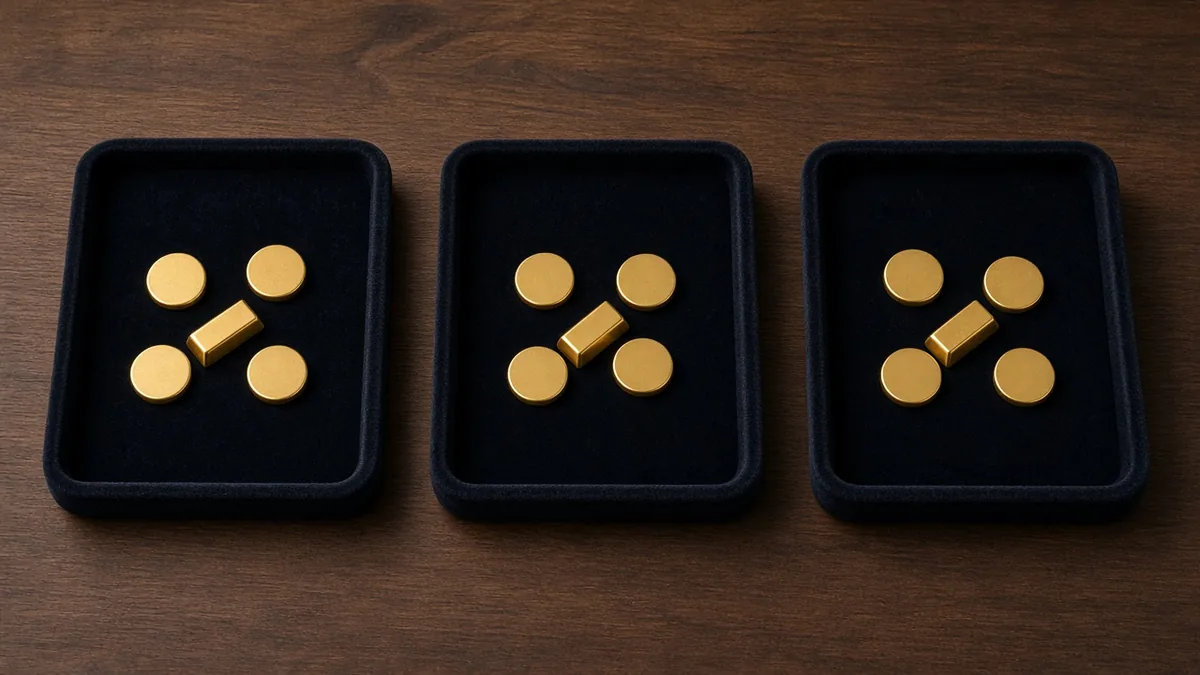
Separate accounts let each heir choose their own path and pay taxes on their own share. One can keep the metals held in the depository, another can sell, and a third can take coins in kind.
Moving inherited metal to another custodian
If you’d rather use a different custodian, a trustee-to-trustee transfer can move the inherited account with the metal in kind. The new account must stay titled as an inherited IRA and can’t be combined with your other IRA. See how to switch gold IRA custodians.
Do you have to pay taxes on gold you inherit?
It depends on where the gold was held. The inheritance itself isn’t income, but distributions from an inherited IRA usually are, and the taxes follow the distributions, not the death.
Gold inside an inherited IRA or other retirement account
Distributions from an inherited traditional gold IRA are taxable distribution income. They’re taxed as ordinary income in the year you receive them, cash or metal, so you pay taxes at your own income tax rate. Pub 559 calls this income in respect of a decedent. State rules may add to that, depending on where you live.
There’s no step up in basis for IRA assets, which are subject to income tax when they come out, so the inheritance doesn’t erase the gain built up inside the IRA. Internal Revenue Code section 1014(c) excludes income in respect of a decedent from the step up rule.
If the owner made nondeductible contributions, part of each distribution may be tax free. The owner’s Form 8606 shows that basis.
Physical gold inherited outside an IRA
Physical gold and other assets left outside an IRA are different, and they aren’t subject to the IRA rules. Pub 551 says inherited property generally takes a basis equal to its fair market value at the date of death. That step up can erase gains during the owner’s life.
Pub 544 says inherited property counts as held for more than one year. So a later sale gets long term capital gains treatment, but gains on coins are taxed at a maximum 28% rate as collectibles (IRS Topic 409). Unlike most stocks, gold is a collectible for this purpose.
After an in-kind distribution
Once metal leaves the inherited IRA and you’ve reported it as ordinary income, any later sale can create capital gains or losses. Long-term capital gains on collectibles are taxed at a maximum 28%. Keep the 1099-R and the custodian’s valuation as your records. Confirm your basis with a CPA for tax purposes. Our gold IRA taxes guide covers the rules.
Estate taxes and the inherited retirement account
An IRA counts in the owner’s estate, like any other retirement account. The estate may owe estate taxes, and the beneficiary owes income taxes on distributions. For 2026, the IRS says the federal estate tax exemption, the basic exclusion amount, is $15,000,000. Most estates owe nothing at the federal level.
If estate tax was paid, Pub 590-B lets the beneficiary deduct the estate tax on income in respect of a decedent. That can soften the tax hit. An estate planning attorney or CPA can help.
Is there any way to avoid taxes on an inherited IRA?
Not for a traditional IRA, except basis from nondeductible contributions. You can manage the tax bill, though: when you pay taxes and how much lands in one year.
Spreading distributions across the 10 years can keep each year’s income, and each year’s taxes, lower than one big withdrawal. Taking everything in one year can push you into a higher bracket and a larger tax burden.
An inherited Roth is different. Qualified withdrawals are generally tax free. That’s why some owners convert before they die; see converting a gold IRA to a Roth.
What is the downside of a gold IRA for heirs?
Fees continue. Storage and custodian costs keep running on the inherited account, and paying them from the IRA shrinks the inheritance.
Selling takes time. Paperwork, a dealer bid, and settlement come before cash, and sale costs reduce the dollars you receive.
No income. Metal pays no interest, unlike bonds or dividend stocks, so an heir relying on income from the inheritance gets none.
Valuation gaps. The value on the statement may differ from what a dealer pays.
These aren’t reasons to sell, but heirs should know them before deciding. See gold IRA withdrawal rules for the exit options.
Is it better to have physical gold or a gold IRA?
For heirs, the difference is basis and timing. Gold and other assets held outside an IRA can get a step up at death, which can make that inheritance cheaper to sell. Gold inside an IRA can’t, but it grew without a yearly bill. Our gold IRA vs. physical gold guide compares both.
Planning ahead if you own a gold IRA
Name a primary and contingent beneficiary, and review the forms after a marriage, divorce, or death. A named beneficiary avoids sending the inheritance through the estate.
Leave heirs a list of the custodian, the depository, and where statements are kept, plus a note on paying ongoing fees. The account number alone isn’t enough.
Explain in writing whether you’d prefer heirs keep metal or sell it, and how you expect them to handle paying taxes. It isn’t binding, but it helps an inheritance go smoothly.
I keep part of my own retirement savings in physical metals in a self-directed IRA. Planning who inherits it is part of owning it.
For the rest of the metals lifecycle, see our gold IRA rollover guide and our gold IRA companies reviews. If you inherited a 401(k) instead, see inherited 401(k).
Written by Tim Schmidt and reviewed for tax and account accuracy by Sean Webster, CPA. Last reviewed November 11, 2026 (America/New_York). This guide is for general education. It is not tax, legal, or investment advice, and it is not a recommendation to buy or sell any metal or to open any account. IRAInvesting.com is not a custodian, dealer, broker-dealer, or investment adviser. Before you act, talk with a licensed tax professional or adviser who can review your situation. Investing in precious metals involves risk, including the possible loss of principal. Metals can be volatile, and they do not pay interest or dividends. Past performance does not guarantee future results.