
Roth Gold IRA: How Physical Gold Works Inside a Roth, and When It Makes Sense
A Roth gold IRA is a Roth account that holds IRS-eligible physical gold instead of, or alongside, stocks and mutual funds. It isn’t a separate account type in the tax code. It’s a self directed gold IRA set up as a Roth, with a custodian that allows precious metals and a trustee that holds the metal in a depository.
The Roth rules don’t change because the asset is gold. Gold IRAs follow the same IRS rules as any other IRA of the same type. You fund it with after tax dollars, qualified withdrawals are tax free, and there are no required minimum distributions while you’re alive. What changes is cost, storage, and how a low-yield asset uses limited Roth space.
IRAInvesting.com may earn a referral fee if you work with one of the gold IRA companies we review: American Hartford Gold, Augusta Precious Metals, GoldenCrest Metals, Goldco, or Noble Gold Investments. That doesn’t change the tax rules on this page. See our affiliate disclosure.

What is a Roth gold IRA?
It’s a precious metals IRA in Roth form: a Roth retirement account whose self directed custodian can hold physical precious metals. The gold IRA owns the metal. You direct purchases, and the custodian, a bank or other financial institution the IRS allows, keeps the records.
Traditional gold IRA vs. Roth
“Gold IRA” is a marketing name, not an IRS term. A gold IRA can be a traditional IRA, a Roth, or a SEP IRA. A traditional gold IRA uses pre-tax or deductible money. The Roth version uses after-tax money. The metal rules are the same in both. The account type decides the tax treatment.
Can I hold gold in my Roth IRA?
Yes, if your custodian allows it and the metal qualifies. Most brokerage Roth accounts don’t hold coins or gold bars, so you’d open a self directed gold IRA as a Roth with a custodian that does. See IRS-approved gold and silver for which products qualify.
How a gold IRA works as a Roth
Eligible gold, silver, platinum, and palladium
Buying collectibles in an IRA is treated as a distribution. Internal Revenue Code section 408(m)(3) carves out two groups of coins and bullion.
Listed coins. The coin list names the gold coins described in 31 U.S.C. 5112(a)(7) through (10), which are the one, one-half, one-quarter, and one-tenth ounce American Gold Eagles. It also names the one-ounce American Silver Eagle under 5112(e), platinum coins under 5112(k), and coins issued under state law. Pub 590-A puts it in plain terms: one, one-half, one-quarter, or one-tenth ounce U.S. gold coins, or one-ounce silver coins minted by the Treasury Department.
Bullion. Gold, silver, platinum, and palladium bullion qualifies if its fineness equals or exceeds the minimum that a regulated futures exchange requires for metal delivered on its contracts. The statute doesn’t print a percentage. It points to the exchange’s delivery rules, so ask your custodian which standard it applies to each product and get the answer in writing.
So a gold IRA can hold gold and silver, along with platinum and palladium, if the product qualifies. Other precious metals and rare coins usually don’t qualify.
Gold bullion and gold bars must stay with the trustee
The bullion exception applies only while the bullion is “in the physical possession of a trustee.” IRS Publication 590-B adds that if the owner takes possession of IRA coins, they’re treated as distributed.
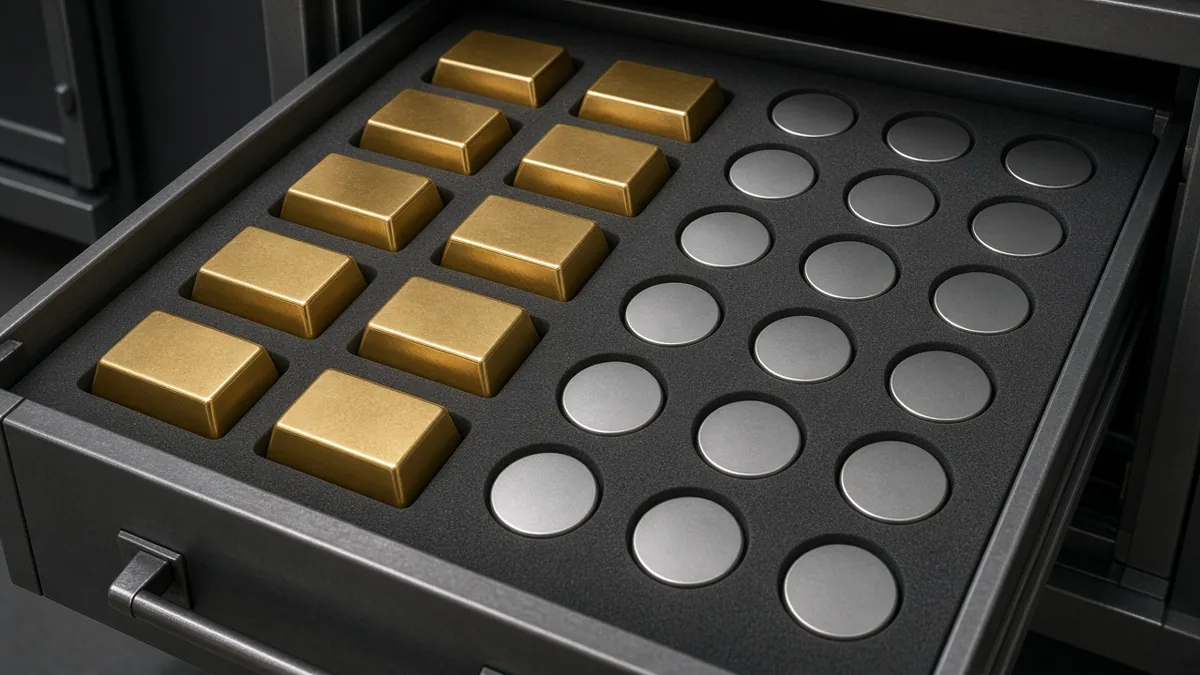
So IRA gold bullion sits at an IRS approved depository the custodian uses, not at home. Our gold IRA storage guide covers segregated and commingled vaults.
Who does what in a gold Roth account
Custodian: a bank or IRS approved nonbank trustee that holds the account. The IRS publishes the list of approved nonbank trustees.
Precious metals dealer: sells you the metal and quotes the price.
Depository: stores the metal for the custodian.
Our gold IRA custodian vs. dealer guide explains each role. Compare self directed IRA custodian options on our self-directed IRA custodians page.
Funding a gold IRA account as a Roth
2026 contribution limits
For 2026, the IRS contribution limits are $7,500, or $8,600 if you’re 50 or older. That cap is shared across all your traditional and Roth accounts. See our IRA contribution limits guide.
Roth income limits for 2026
Roth contributions phase out at modified adjusted gross income of $153,000 to $168,000 for single filers and $242,000 to $252,000 for married couples filing jointly (IRS, 2026 figures).
Above the range you can’t contribute directly. Higher earners sometimes use a conversion instead.

Moving an existing IRA into gold
Many people fund a precious metals IRA by moving an existing retirement account. Transferring funds from one Roth, or other retirement account of the same type, by trustee-to-trustee transfer isn’t taxed and doesn’t count as a contribution. An indirect rollover is riskier: the money or metal is paid to you, and you have 60 days to deposit it in the new account, with only one IRA-to-IRA rollover allowed in any 12-month period. That’s why a direct transfer is usually the cleaner way to fund a gold IRA. Our guide to an IRA transfer vs. rollover explains the difference.
Gold IRA rollover from a Roth 401(k)
A gold IRA rollover from a Roth 401(k) or another designated Roth account can go to a Roth account that holds gold. An old retirement account with pre-tax money goes to a traditional IRA unless you convert it. See our gold IRA rollover guide.
Converting a traditional gold IRA
If you already own a traditional gold IRA, you can convert some or all of the metal to a Roth. You’ll owe income tax on the value converted. See how to convert a gold IRA to a Roth.
SEP gold IRAs and other account types
SEP gold IRAs are usually traditional accounts, so a SEP IRA follows traditional tax rules. Federal reporting rules now also cover Roth SEP and Roth SIMPLE accounts if the employer’s plan offers them. Ask the custodian which account type it can hold metal in.
How gold in a Roth is taxed
Tax advantaged growth
A Roth is a tax advantaged retirement account. Sales inside the gold IRA aren’t taxed each year, so you can swap gold for silver coins without a tax bill. The gold IRA gets the same tax advantages as a Roth holding funds, because tax advantaged status comes from the account, not the asset.
The five-year rule and qualified withdrawals
A qualified distribution is tax free.
It must come after the five-year period that starts with your first Roth contribution year, and on or after age 59½, disability, death, or a qualified first-time home purchase. Withdrawals of your own contributions come out first and aren’t taxed.

No lifetime RMDs
Pub 590-B says you aren’t required to take distributions from your Roth IRA at any age.
With a traditional IRA, RMDs can force you to sell metal or take coins in kind each year. A Roth avoids that while you’re alive.
Beneficiaries do have rules. See our inherited gold IRA guide.
What happens when metal comes out
You can take a gold IRA distribution in cash or in kind. Pub 590-B says the basis of property distributed from a Roth IRA is its fair market value on the date of distribution. If you later sell those coins outside the IRA, gains above that basis can be taxed at up to 28% as collectibles (IRS Topic 409).
That’s a different tax treatment from a traditional IRA, where the distribution is ordinary income. Our gold IRA withdrawal rules and gold IRA taxes guides cover both.
Roth vs. traditional gold IRA
Which account type fits?
Roth: pay tax now and get tax free qualified withdrawals later. No lifetime RMDs.
Traditional: a traditional IRA may give a deduction now, with ordinary income later. RMDs start at age 73.
The choice turns on your tax rate now versus later, not on gold or other precious metals. Traditional retirement accounts and Roth accounts follow the same rules on which metal a gold IRA account can hold.
Is gold the best use of Roth space?
Tax advantaged Roth space is limited. Gold doesn’t pay dividends, unlike paper assets such as dividend stocks, so a Roth gold position only benefits if the price rises. Some investors keep the retirement assets they expect to grow most in a Roth and hold precious metals in traditional retirement accounts.
Others want metal in the Roth so any gain is never taxed. No single answer fits every retirement portfolio, so a financial advisor can look at your retirement savings and retirement portfolio as a whole.
Gold IRA pros and cons in a Roth

Gold IRA pros
Tax-free gains. Qualified withdrawals are tax free, including any gain on the metal.
No forced sales. There are no RMDs while you’re alive.
Real metal. You hold physical gold through the gold IRA, not a fund share.
A different asset. It adds metal to retirement savings held mostly in paper assets such as stock market funds and mutual funds.
What are the disadvantages of a gold IRA?
Costs. Expect setup, an annual ira fee, storage fees, and the dealer’s spread on buying and selling.
No income. Gold and other precious metals don’t pay dividends.
Price swings. Market volatility and market fluctuations cut both ways.
Less access. You can’t hold the metal yourself while it’s in the retirement account, unlike gold and silver you buy directly.
Slower exits. Selling precious metals from a gold IRA takes custodian paperwork and a dealer bid.
Is a gold Roth IRA a good investment?
It fits some investors and not others. Gold is often called a safe haven asset during economic uncertainty, but it can fall, sometimes for years, and buying during economic uncertainty guarantees nothing. A Roth doesn’t make a gold IRA safer. It changes how gains are taxed.
How gold IRA fees affect a Roth
Storage fees and transaction fees
Gold IRAs require a custodian and a depository, so expect a fee schedule with setup, annual, storage fees, and transaction fees, plus the dealer spread. These vary by gold IRA custodian and dealer, and we don’t quote fees we haven’t seen in writing. Our gold IRA fees guide lists what to ask for.
Why fees matter more in a Roth
With a $7,500 yearly cap, flat storage fees take a larger share of a small gold IRA. Ask whether fees can be billed outside the gold IRA, and get the answer in writing.
How to open a gold IRA as a Roth
Steps to open a gold IRA
- Pick a self directed ira custodian on the IRS approved nonbank trustee list (or a bank) that holds metals and offers Roth accounts.
- Open a Roth account and sign the depository agreement.
- Fund it with a contribution, a Roth-to-Roth transfer, or a conversion.
- Choose a precious metals dealer and approve a written quote.
- Direct the custodian to pay for the metal and confirm it’s in the IRS approved depository the custodian uses.
For the general Roth steps, see how to open a Roth IRA. Our Roth IRA guide covers the account itself.
Choosing among gold IRA companies
Gold IRA companies are usually gold, silver, and precious metals dealers that work with a custodian; most gold IRA companies don’t hold the account. Before you open a gold IRA with one, check its Better Business Bureau file and get buyback terms in writing. Our editorial policy says we review Better Business Bureau records too. Our best gold IRA companies page lists the firms we review, including American Hartford Gold, and our scoring. Compare gold IRA companies on written fees, not ads.
Purchase gold only after you see the full quote
Purchase gold for the IRA only after you see the product, premium, spot reference, and total cost on paper.
Avoid collectible coins sold as “IRS approved.” The IRS keeps no approved list of dealers or coins, only rules on which metal qualifies.
How does a gold IRA work at year end?
Statements and Form 5498
Each year the custodian reports the gold IRA’s fair market value on Form 5498, using its own pricing for your coins and bars. Ask how it values physical precious metals.
Watching gold prices
Gold prices move daily, and your gold IRA statement moves with them. Hold physical gold in a gold IRA only if you can ride that out.
What if I invested $1000 in gold 25 years ago?
We don’t publish a figure without a verified price source for both dates. To work it out, divide today’s price per ounce by the price on your start date, then multiply by $1,000.
Subtract premiums, storage, and fees. In a Roth, a qualified withdrawal of the result would be tax free. Past results don’t predict future ones.
Before you decide
Questions to ask
- Does the custodian offer a self directed retirement account as a Roth, and can it hold physical precious metals?
- Which depository, and is storage segregated or commingled?
- What are all the fees, and can you pay them from outside the retirement account?
- What’s the buyback process when you want to sell?
I keep part of my own retirement savings in physical metals in a self-directed IRA, held at a depository. The tax rules here come from IRS publications. Ask a qualified tax professional or financial advisor whether a gold Roth fits and how much of your retirement account belongs in precious metals. For alternative investments and other assets in a self-directed IRA, see our self-directed IRA guide.
Written by Tim Schmidt and reviewed for tax and account accuracy by Sean Webster, CPA. Last reviewed November 11, 2026 (America/New_York). This guide is for general education. It is not tax, legal, or investment advice, and it is not a recommendation to buy or sell any metal or to open any account. IRAInvesting.com is not a custodian, dealer, broker-dealer, or investment adviser. Before you act, talk with a licensed tax professional or adviser who can review your situation. Investing in precious metals involves risk, including the possible loss of principal. Metals can be volatile, and they do not pay interest or dividends. Past performance does not guarantee future results.