
Gold IRA Taxes: How Traditional, Roth, and SEP Gold IRAs Are Taxed
Taxes on a gold IRA follow the account, not the metal. A gold IRA is a self directed IRA that holds physical precious metals instead of mutual funds or publicly traded stocks. The IRS taxes it under the same tax rules as any traditional or Roth IRA. What changes is storage, paperwork, and a few traps specific to precious metal assets.
I rolled part of my own retirement savings into a gold IRA and keep physical precious metals in a self directed IRA. This guide is for savers who own a gold IRA or are weighing one. Each of the gold IRA tax rules below is tied to an IRS publication, the tax code, or a CFTC bulletin.

How taxes work in a gold IRA
Inside the account, buying or selling precious metals doesn’t trigger taxes. Funds invested in the account aren’t taxed each year. Taxes come when money or precious metals leave the account as a distribution. IRA owners pay taxes on distributions. Trades among IRA investments aren’t taxed.
That makes a gold IRA a tax wrapper for precious metals. The tax advantages are the same as other retirement accounts: tax deferral in a traditional IRA and qualified withdrawals that are tax free in a Roth IRA. The precious metals themselves get no special break.
Gold IRA tax rules for Roth IRAs and traditional IRAs
Traditional IRAs are taxed on the way out. There are no separate gold IRA rules. The gold IRA rules for IRA owners are the IRS rules for all retirement accounts. A traditional gold IRA follows traditional IRA rules, a Roth gold IRA follows Roth IRA rules, and SEP gold IRAs follow the rules for SEP IRAs. The withdrawal rules, the RMD rules, and the 10% additional tax on early withdrawals are the same as for traditional IRAs and Roth IRAs that hold mutual funds.
How a traditional gold IRA is taxed
Contributions to a traditional gold IRA may be deductible, depending on income and workplace plan coverage, under Publication 590-A. Growth is tax deferred.
When you take a distribution, it’s taxed at ordinary income tax rates, except any nondeductible basis tracked on Form 8606. Under 59½, early withdrawals can also face the 10% additional tax unless an exception applies.
Required minimum distributions RMDs
A traditional gold IRA is subject to required minimum distributions RMDs. Publication 590-B sets the start at age 73 for owners who reach 72 after 2022.
Publication 590-B lets a traditional IRA owner with one or more accounts figure each RMD separately, then take the total from any one or more of the individual’s traditional IRAs. That can leave a precious metal account untouched while a cash IRA covers the RMD. See our gold IRA RMD guide.
How a Roth gold IRA is taxed
Roth contributions aren’t deductible, so you pay income tax up front, and income limits apply to IRA owners who want to contribute, per Publication 590-A.
Qualified withdrawals are tax free. Publication 590-B says a distribution is qualified if it’s made after the 5-year period beginning with your first Roth contribution year and is made at 59½ or later, because you’re disabled, to a beneficiary after your death, or for a first home (up to $10,000 lifetime). A return of your regular contributions isn’t included in income either. Roth IRAs have no RMDs during the owner’s lifetime.
Converting a traditional gold IRA to a Roth gold IRA
A Roth conversion is taxable. The converted value, including the fair market value of any precious metals moved, is subject to income tax for the year. See converting a gold IRA to a Roth and our Roth gold IRA guide.
SEP gold IRAs and other account types
Publication 590-B says references to traditional IRAs generally include traditional SEP IRAs, and references to Roth IRAs generally include Roth SEP IRAs. So SEP gold IRAs are taxed like the traditional or Roth IRA they are. Gold IRAs share the normal IRA limits; there’s no separate one. For 2026, the limit for a traditional or Roth IRA is $7,500, plus a $1,100 catch-up if you’re 50 or older ($8,600), under IRS news release IR-2025-111.
Contributions must be cash. IRC 408(a)(1) says no contribution will be accepted “unless it is in cash,” so you can’t contribute gold you already own. You fund the account, then the IRA buys the metal.
What can trigger taxes in a gold IRA
Most tax events in a gold IRA come from three things:
- A taxable distribution of cash from sale proceeds.
- An in-kind distribution of precious metal coins or bullion bars.
- A Roth conversion.
A qualified Roth distribution is tax free, so it isn’t on that list.
Cash and in-kind distributions of IRA gold
When IRA gold is shipped to you, the 2026 Form 1099-R instructions report it at its fair market value on the date of distribution. From a traditional IRA, that value is generally taxable income. See gold IRA withdrawal rules, in-kind distributions, and how to sell gold in an IRA.
IRS requires a trustee to hold IRA metals
A gold IRA requires an IRA trustee to hold the physical metals. Publication 590-B says IRA coins must be in the possession of the custodian or trustee, and if you take physical possession of them, they’re treated as distributed to you. The Tax Court reached that result in McNulty v. Commissioner (157 T.C. No. 10), where IRA coins kept at home were a taxable distribution.
You may see “IRS approved depository.” The IRS approves banks and certain nonbank trustees, not vaults. Your IRA trustee chooses the depository for IRA metals. See our gold IRA storage page.

Buying collectibles in an IRA
IRS collectibles guidance says buying a collectible with IRA money is treated as a distribution of its cost, generally taxed as ordinary income. That’s why precious metal purchases must be eligible gold or other eligible metals.
Eligible metals and the IRS rules on collectibles
IRC 408(m) treats most coins and precious metals as collectibles, with exceptions. The exceptions, often called approved metals, include certain gold, silver, and platinum coins, such as American Gold Eagle coins, American Silver Eagle coins, and American Platinum Eagle coins. They also include precious metal bullion: gold, silver, platinum, and palladium bullion that meets the fineness a regulated futures contract market requires, held by a trustee.
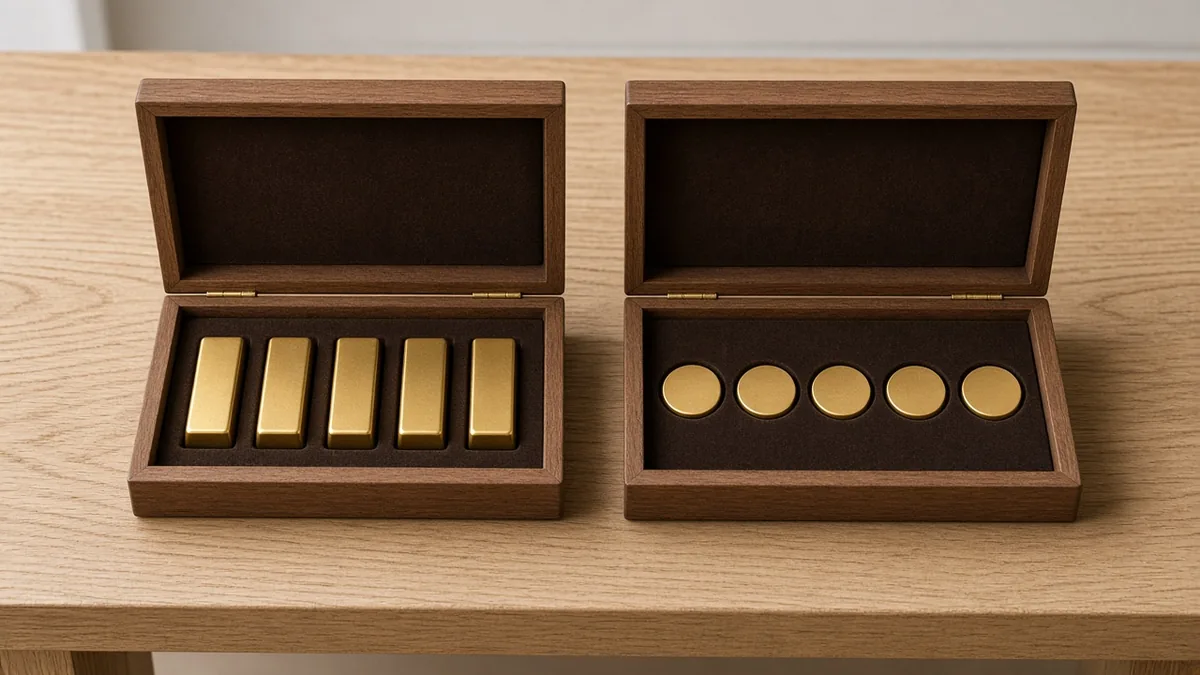
Gold bars, silver bars, and eligible coins
So a precious metals IRA can hold gold, silver, platinum, and palladium in qualifying forms. Eligible gold includes those coins and qualifying bars, and silver bullion can qualify too. See IRS-approved gold and silver for eligible metals.
Physical gold vs a gold IRA: taxes on precious metals
Holding precious metal assets outside an IRA is different: physical metals are collectibles. IRS Tax Topic 409 says net capital gains from selling collectibles such as coins “are taxed at a maximum 28% rate.” Gains on precious metals held one year or less are short-term and taxed at ordinary income tax rates.
For precious metal assets held in a gold IRA, the 28% rate doesn’t apply while the precious metals stay in the account. See gold IRA vs physical gold.

Precious metal ETFs, mining stocks, and mutual funds
Precious metal ETFs, mining stocks, and mutual funds are securities, not precious metals. Inside an IRA, they’re taxed like other IRA investments. The tax treatment of precious metal ETFs held outside an IRA depends on how each fund is structured, so check the fund’s tax disclosures. Compare them in gold IRA vs gold ETF.
Does the IRS know if I buy gold?
Inside an IRA, yes. Your custodian files Form 5498 each year, which the 2026 instructions say shows the account’s fair market value on December 31. Distributions go on Form 1099-R.

Outside an IRA, a purchase of precious metals isn’t itself an income tax event, but you report gains when you sell.
What is the downside of a gold IRA?
The tax rules are the same as other IRAs, but the costs aren’t. Precious metals IRAs carry custodian and storage fees, and the CFTC warns that dealers sell above spot and buy back below it. Precious metals pay no interest or dividends. Keep enough liquid assets to cover RMDs and any tax bill. Our gold IRA fees page covers costs.
Why do some financial commentators say not to invest in gold?
Critics point out that gold and other precious metals produce no income and prices can swing, so size precious metals carefully within a retirement portfolio. A gold IRA can be one part of a retirement strategy, not a guarantee of returns.
Final thoughts on gold IRA taxes
For IRA owners, it comes down to three things: the account type, what you take out, and keeping your precious metals with the IRA trustee. The account type sets the tax on all IRA investments. Then the gold IRA tax rules are the same ones every IRA owner follows.
If you’re comparing providers, see our gold IRA companies page, and see our gold IRA rollover guide for moving money in. Our tax strategy hub covers broader planning. IRAInvesting.com may earn a referral fee from companies we review. See our affiliate disclosure.
Written by Tim Schmidt and reviewed for tax and account accuracy by Sean Webster, CPA. Last reviewed November 11, 2026 (America/New_York). Tax figures reflect IRS guidance for 2026 as of that date. This guide is for general education. It is not tax, legal, or investment advice, and it is not a recommendation to buy or sell any metal or to open any account. IRAInvesting.com is not a custodian, dealer, broker-dealer, or investment adviser. Before you act, talk with a licensed tax professional or adviser who can review your situation. Investing in precious metals involves risk, including the possible loss of principal. Metals can be volatile, and they do not pay interest or dividends. Past performance does not guarantee future results.