
How to Take Physical Possession of Gold IRA Metal: The In-Kind Distribution Process
You can hold physical gold that came from a gold IRA in your own hands. The legal way is a distribution in kind: the custodian releases the gold coins or bars to you, reports their value to the IRS, and the gold leaves the retirement account for good.
That is different from keeping IRA gold at home while it is still in the gold IRA. The first is a reportable withdrawal. The second is the home storage problem the Tax Court has already ruled on. This guide explains the lawful process step by step: the request, the valuation, withholding, shipping, the taxes, and what owning physical gold means afterward.
I hold physical precious metals in a self directed IRA myself, kept at a depository, not at home. Sean Webster, CPA, reviewed this guide against IRS Publication 590-B and the 2026 Instructions for Forms 1099-R and 5498.
IRAInvesting.com may earn a referral fee if you work with a gold IRA company we review. That does not change the IRS rules below. See our affiliate disclosure.

Physical possession of gold IRA assets is a distribution
A gold IRA is a retirement account first: a traditional IRA, Roth IRA, or SEP IRA that holds gold and other precious metals instead of funds. It is usually a self directed IRA. The IRA owns the gold. You, the IRA owner, direct the account, but you do not hold the gold IRA assets.
The Internal Revenue Service is direct on this point. Publication 590-B says IRA coins “must be in the possession of the custodian or trustee of the IRA. If the owner or the beneficiary of the IRA takes possession of the coins, the coins will be treated as distributed.”
That rule covers every gold IRA and every self directed IRA that holds precious metals. The Internal Revenue Service makes no exception for a gold IRA owner who wants physical possession for safekeeping.
So physical possession and a distribution are the same event for tax purposes. There is no way to hold gold from a gold IRA personally and keep it inside the retirement account. The only question is whether the distribution is done properly and reported.
Lawful distribution vs. home storage
A proper distribution is requested, valued, and reported on Form 1099-R. Home storage of gold the IRA still owns is not a lawful substitute, because the IRS requires the custodian or trustee to hold it.
In McNulty v. Commissioner, 157 T.C. No. 10 (2021), IRA owners used a checkbook IRA. A limited liability company owned by the IRA bought American Eagles, and the gold coins were kept at the owners’ home. The Tax Court ruled that taking possession of the American Eagles was a taxable distribution, and it upheld accuracy-related penalties. Personal use of IRA assets can also be a prohibited transaction. Pub. 590-B says a prohibited transaction can end the account’s IRA status, with all its assets treated as distributed.
A pitch for a “home storage gold IRA,” or a personal safe deposit box for IRA coins, is a red flag. Home ownership of the gold only comes after a real distribution. Our gold IRA storage guide covers the home storage rules in detail.
Who holds IRA gold before a distribution
Until a distribution, IRS regulations require the custodian or trustee to keep possession. In practice, the custodian uses an IRS approved depository, and your physical gold and silver are securely stored there for the retirement account.

There is no IRS list of approved investments. “IRS approved” in gold IRA marketing usually means the coins and bullion meet IRS requirements under IRC 408(m) and that an approved trustee holds them. Those are strict rules. American Gold Eagles are among the U.S. coins the tax code names in IRC 408(m)(3)(A). For bullion, IRC 408(m)(3)(B) points to the minimum fineness a futures exchange requires for delivery and states no percentage, so ask your custodian for its purity standard in writing before you buy metals or take delivery. Our IRS-approved gold and silver guide explains how precious metals qualify.
Your chosen depository matters at exit time, because that is where shipping starts. An IRS approved depository holds metals for many clients, so ask how it identifies your exact gold. Our custodian vs dealer guide explains who does what.
How to request a distribution in kind, step by step
These steps describe the general process. Each custodian has its own set of forms and fees, so read yours.
1. Confirm exactly what the IRA owns
Ask for a current holdings statement that lists each product, its weight, and its quantity: the IRA gold, silver, and other precious metals. Ask which IRS approved depository holds it. Decide which gold you want delivered. You can take some metals and leave the rest.
2. Submit the request (your gold IRA company can help)
The request goes to the custodian, not the dealer. Your gold IRA company may help you fill it out, but only the IRA custodian can release the metals. The form usually asks for the products, the delivery address, and whether the retirement account is a traditional IRA or Roth IRA.
3. Choose your federal withholding
Pub. 590-B says federal income tax is generally withheld at 10% from nonperiodic IRA distributions unless you elect otherwise on Form W-4R. The 1099-R instructions say withholding cannot exceed the cash plus the value of property distributed. If you want tax withheld on a gold-only distribution, ask the custodian whether it needs cash in the account.
4. The gold is valued on the distribution date
The 2026 Form 1099-R instructions say: “If you distribute employer securities or other property, include in box 1 the FMV of the securities or other property on the date of distribution.” For gold, that fair market value is the taxable starting point. Ask your custodian which price source and time of day it uses, and keep that record.

5. Shipping, insurance, and delivery
The depository packs your gold IRA coins and bars and ships them to you. Ask who pays shipping and insurance, how the package is tracked, and who bears the risk until you sign. We do not quote a typical fee for this, so get the custodian’s and depository’s current fee schedules in writing.
Taxes when you take physical gold from an IRA
The tax depends on the account type, not on taking gold instead of cash. The same rules apply to all precious metals: silver, platinum, and palladium.
Traditional IRA: income tax on the value
From a traditional IRA, the value on the distribution date is generally taxable as ordinary income. If you made nondeductible contributions, part of it may be a tax-free return of basis, tracked on Form 8606. The 28% collectibles rate does not apply to the IRA distribution itself.
Roth IRA: tax free if qualified
A qualified distribution from a Roth gold IRA is tax free, whether it is cash or gold. Pub. 590-B adds that the basis of property distributed from a Roth IRA “is its fair market value on the date of distribution, whether or not the distribution is a qualified distribution.”
Early withdrawal penalties before age 59½
If you are under 59½, the 10% additional tax can apply on top of income tax unless an exception fits. Early withdrawal penalties apply to gold IRA distributions the same way as to cash. See our early withdrawal exceptions guide.
Using gold to satisfy required minimum distributions
If you are 73 or older, a gold IRA distribution of physical metals can help cover required minimum distributions from a traditional IRA. Our gold IRA RMD guide explains the timing and valuation. For the full tax picture, see gold IRA taxes.
Owning physical gold after the distribution
Once delivered, the precious metals are yours: direct ownership of a tangible asset, with no IRA rules and no tax deferred growth. Owning physical gold this way is the same as purchasing physical gold from a dealer, except for how you got it.
Outside an IRA, IRS Topic 409 says net capital gains from selling collectibles such as coins are taxed at a maximum 28% rate. IRC 1(h)(5) defines collectibles using the IRA definition but without the bullion exception, so gold bars count too. Your basis for a Roth distribution is the value on the distribution date. For a traditional IRA distribution, ask your tax adviser to confirm your basis and holding period before you sell.
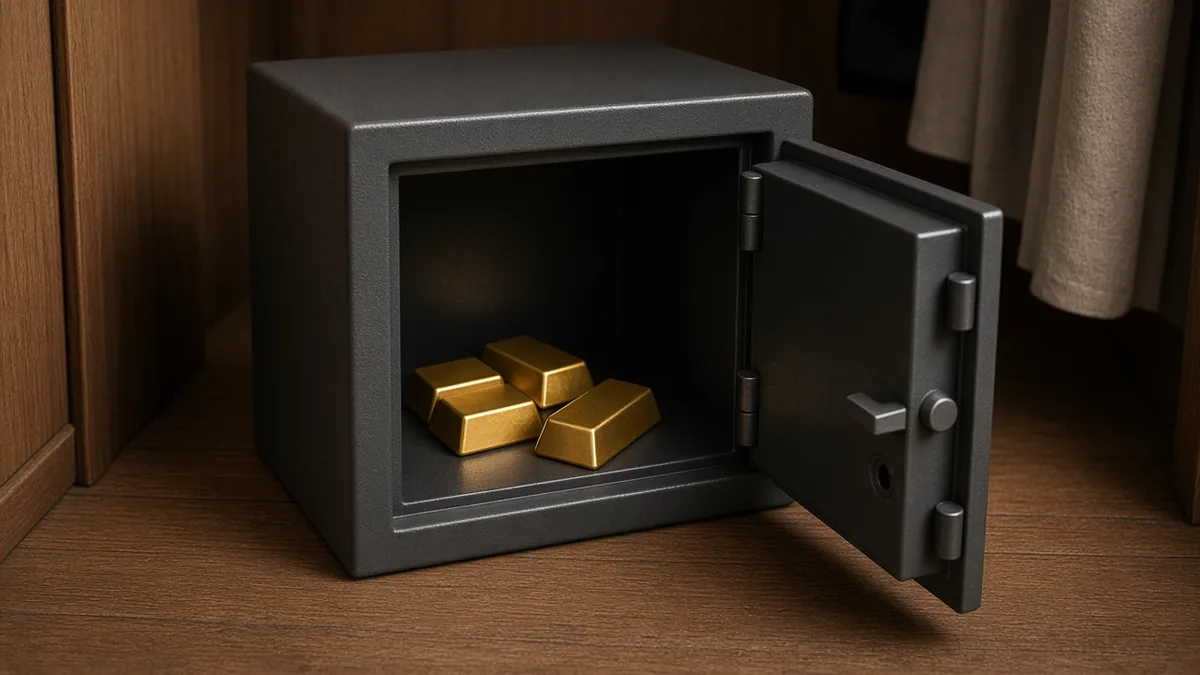
Where you hold gold now is your choice: a home safe, a bank safe deposit box, or a private vault. You also carry the insurance. Physical metals at home raise the same theft and insurance questions as other valuables, so check your homeowner’s coverage.
Can you put IRA metals back? Rollovers and contribution limits
Only in limited ways. Pub. 590-A says a rollover of distributed property is tax free only if you contribute the same property that was distributed, within 60 days. Only one IRA-to-IRA rollover is allowed in any 12-month period.
Adding physical gold as a regular contribution is not allowed. Pub. 590-A says contributions must be in money, and “property can’t be contributed.” Annual contribution limits for 2026 are $7,500, or $8,600 at age 50 or older (IRS IR-2025-111). To buy gold in an IRA, you contribute cash and the IRA does the purchasing. Purchasing gold with retirement funds always runs through the custodian.
To move gold between IRAs without a distribution, use a trustee-to-trustee transfer. See our guide to switching gold IRA custodians.
Is it better to hold physical gold in a gold IRA or outside an IRA?
Keeping gold in a precious metals IRA keeps the tax advantages: tax-deferred or tax-free growth and no tax on sales inside the account. Holding physical gold outside an IRA gives you direct access, but purchasing gold that way means you buy gold with after-tax money and pay tax on any later gain.
Many investors weigh gold IRA tax advantages against direct access, and gold against traditional investments like stocks and bonds. Some buyers say gold has historically served as a hedge during economic uncertainty. Gold prices still rise and fall during economic uncertainty and calm alike, and an IRA does not change that. Our gold IRA vs physical gold guide compares the two paths.
What is the downside of a gold IRA when you want the gold?
Every exit has a cost. A gold IRA has custodian fees, sometimes called management fees, plus storage fees and possible shipping or distribution charges. Our gold IRA fees guide breaks these down. The CFTC warns that a dealer sells gold above the spot price and buys it back below, and that collectible coins are often harder to sell than bullion.
You also give up the tax advantages for whatever you take out of your retirement savings. Once gold leaves, you cannot put it back except through the narrow rollover window above.
How do you cash out a gold IRA instead?
If you want money, not gold, the custodian sells the gold inside the gold IRA and then distributes cash. Our guide on how to sell gold in an IRA covers bids and spreads, and our gold IRA withdrawal rules hub compares both paths.
Does the IRS know if I buy gold in an IRA?
Yes. The custodian files Form 5498 each year with the account’s value and Form 1099-R for each distribution, including gold distributions. IRS rules apply to every gold IRA move.
Checklist before you take physical possession

Before you ask a gold IRA custodian to ship physical gold, run through this list:
- Get a holdings list and pick the gold you want.
- Get the custodian’s distribution form and fee schedule.
- Elect withholding on Form W-4R.
- Confirm how the value will be set.
- Confirm shipping, insurance, and signature terms.
- Plan storage and insurance for gold you will own.
- Talk with a tax professional or financial advisor about the tax implications for your retirement portfolio and retirement savings.
If you are still deciding whether a gold IRA fits your personal finance plan, our personal finance guides start with the gold IRA rollover and our gold IRA companies comparison.
Written by Tim Schmidt and reviewed for tax and account accuracy by Sean Webster, CPA. Last reviewed November 11, 2026 (America/New_York). Tax figures reflect IRS guidance for 2026 as of that date. This guide is for general education. It is not tax, legal, or investment advice, and it is not a recommendation to buy or sell any metal or to open any account. IRAInvesting.com is not a custodian, dealer, broker-dealer, or investment adviser. Before you act, talk with a licensed tax professional or adviser who can review your situation. Investing in precious metals involves risk, including the possible loss of principal. Metals can be volatile, and they do not pay interest or dividends. Past performance does not guarantee future results.