
Gold IRA vs Physical Gold: Owning Metal in an IRA or Buying It Directly
A gold IRA and physical gold you buy yourself can hold the very same coins. The difference is who owns them and which rules apply. In a gold IRA, the retirement account owns the metal, a trustee holds it, and IRA tax rules decide what you owe. When you buy physical gold directly, you own it, you hold it, and the collectibles rate applies when you sell.
This guide compares a gold IRA vs physical gold on taxes, storage, access, fees, and IRS rules. Sources are IRS Publications 590-A, 590-B, 551, and 544, IRS Tax Topic 409, and Internal Revenue Code section 408(m).
I keep part of my own retirement savings in physical metals inside a self-directed IRA, so I’ve dealt with the IRA side directly. The tax comparisons below come from IRS sources, not from my own returns.
IRAInvesting.com may earn a referral fee if you work with one of the gold IRA companies we review. That doesn’t change the rules or the comparison here. See our affiliate disclosure.
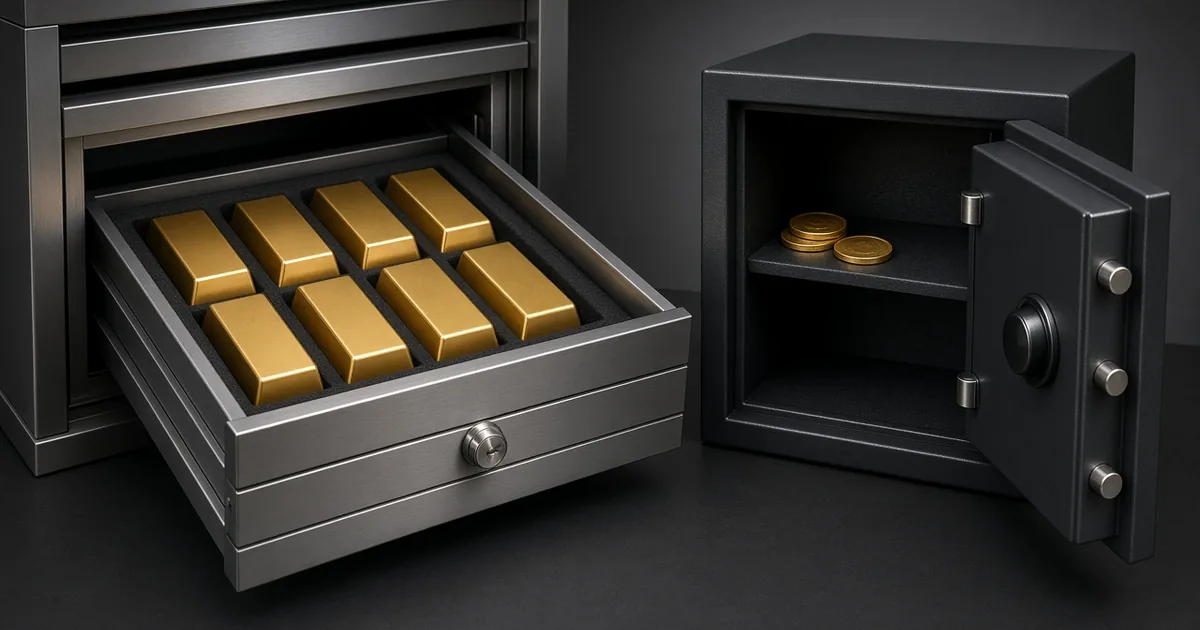
Gold IRA vs physical gold: the key differences
Here are the key differences between a gold IRA vs physical gold at a glance.
Who owns it. In a gold IRA, the IRA owns the metal. With physical gold, you have direct ownership.
Where it’s kept. Gold IRA metal stays with the trustee at an IRS approved depository. Physical gold can sit in a home safe, a bank safe deposit box, or a private vault.
Tax treatment. A gold IRA follows IRA tax rules: tax deferred growth in a traditional IRA, tax free qualified withdrawals in a Roth. Physical gold you own is a collectible, and long-term gains are taxed at up to 28%.
Limits. A gold IRA has yearly contribution limits. Gold you buy outside an IRA has no cap.
Access. You can’t hold the gold IRA metals yourself. You can hold, move, or sell physical gold whenever you like.
Fees. A gold IRA adds custodian and storage fees. Physical gold has storage and insurance fees only if you pay for them.
How a gold IRA works
A gold IRA is an individual retirement account, usually a self directed IRA, whose custodian lets it buy eligible metal. Think of it as a self directed retirement account that holds physical precious metals instead of stocks. It can be a traditional gold IRA, a Roth gold IRA, or a SEP IRA. The tax treatment comes from the account type, not from the gold.
IRA rules on which gold qualifies
Under Internal Revenue Code section 408(m), buying collectibles in an IRA is treated as a distribution. Section 408(m)(3) carves out two groups. The coin group names the one, one-half, one-quarter, and one-tenth ounce American Gold Eagles described in 31 U.S.C. 5112(a), plus the one-ounce American Silver Eagle and certain platinum coins. The bullion group covers gold, silver, platinum, and palladium at least as fine as a regulated futures exchange requires for delivery, held by a trustee. The statute doesn’t print a percentage, so ask a custodian which standard it applies. Bullion coins such as Canadian Gold Maple Leafs can qualify when they meet that standard. Most rare and numismatic coins don’t.
See IRS-approved gold and silver for details. The IRA rules also cover silver, platinum, palladium, and other precious metals.
Who holds the metal in a gold IRA
The bullion exception applies only while the bullion is in the physical possession of a trustee. That’s a bank or an IRS approved nonbank trustee, which uses an IRS approved depository. Pub 590-B says that if the owner takes possession of IRA coins, they’re treated as distributed.
So you can’t keep gold IRA metal at home or in your own safe deposit box. Our gold IRA storage guide explains why home storage pitches fail.
For 2026, the IRA contribution limit is $7,500, or $8,600 at 50 or older, across all your IRAs. Most people fund a gold IRA by moving retirement funds from an existing retirement plan or IRA instead. A direct transfer keeps the money inside a retirement account the whole time. See our gold IRA rollover guide.
How owning physical gold works
Owning physical gold outside an IRA is simpler. You buy physical gold from a dealer with money you’ve already paid tax on, and you take delivery or pay for storage.
You choose what to buy: gold coins, bars, or rare coins that an IRA couldn’t hold. There’s no custodian and no contribution cap. Purchasing gold this way is direct ownership in the plainest sense.
Storage options for physical gold
Home safe. You have immediate physical possession, but theft and fire risk sit with you. Check whether your homeowner’s policy covers metal, and at what limit.
Bank safe deposit box. It keeps gold away from home. The FDIC says deposit insurance doesn’t cover safe deposit boxes or their contents, so ask the bank and consider separate coverage.
Private vault. A private vault stores and usually insures metal for a fee. Read what the storage agreement covers.

Each option trades cost against control. Storage and insurance fees on physical gold are yours to pay, just as a gold IRA pays a depository.
Buying gold for a gold IRA vs buying gold yourself
The buying process shows the gold IRA vs physical gold contrast clearly.
Buying gold for a gold IRA
First you open a gold IRA with a custodian that holds precious metals. Then you fund it with a contribution, a transfer, or a rollover. Next you pick a dealer, choose eligible metal, and the custodian pays for it from the retirement account.
The dealer ships the metal to the depository, not to you. Your statements show what the retirement account owns. Many gold IRA companies coordinate these steps, but the custodian is the one holding your retirement assets.
Buying physical gold on your own
You choose a dealer, agree on a price, and pay. The dealer ships the gold to you, or to a vault you’ve picked.
There’s no account to open and no form to sign beyond the sale itself. You also skip the IRA’s metal standards. Keep your receipts, since they show your basis when you sell and pay taxes on any gain.
Tax treatment: gold IRA vs physical gold
Taxes are where gold IRA vs physical gold differ most, and the tax benefits of each depend on your situation. Precious metals held either way can rise or fall, so the tax angle is only part of the decision.

Taxes on physical gold
IRS Tax Topic 409 says net capital gains from selling collectibles, such as coins, are taxed at a maximum 28% rate. Gold bullion and gold coins you own directly count as collectibles.
That rate applies to long-term gains, on gold held for more than one year. Gains on gold held one year or less are taxed as ordinary income.
Your basis is generally what you paid, including the dealer premium. When you sell physical gold for more than your basis, you pay capital gains tax on the difference. When you sell at a loss, ask a tax professional how it’s treated.
There’s no tax while you simply hold it. You pay capital gains tax only when selling gold, swapping it, or otherwise disposing of it.
Taxes in a gold IRA
Inside a gold IRA, buying and selling gold isn’t taxed each year. The tax benefits come from the retirement account type, and they’re the main reason people accept the extra costs.
Traditional IRA. Contributions may be deductible, and growth is tax deferred. Withdrawals, in cash or metal, are taxed as ordinary income, not at the 28% collectibles rate. That can be higher or lower than 28%, depending on your bracket.
Roth IRA. Contributions are made with after-tax money. Qualified withdrawals are tax free, including any gain on the gold.
Before age 59½, an IRA withdrawal may also face the 10% early withdrawal penalty, which the IRS calls an additional tax, unless an exception applies. See our IRA early withdrawal exceptions guide.
What happens when gold leaves the IRA
You can take the metal out of a gold IRA in kind. A traditional IRA distribution of coins is taxable income at their fair market value. Once the metal is yours, later gains follow the same tax rules as other physical gold you own. Our gold IRA in-kind distribution guide covers the steps.
Traditional IRAs also have required minimum distributions starting at age 73. Physical gold you own has no RMDs.
Which tax path costs less?
It depends on your bracket, your holding period, and the account type. There’s no single answer, and the internal revenue service doesn’t favor either path.
A traditional gold IRA trades a possible deduction now for ordinary income tax later. A Roth trades tax now for tax free gains. Physical gold offers no deduction, but long-term gains face at most 28%. Our gold IRA taxes guide walks through every stage.
Access and control
With physical gold, you can see it, move it, and sell it without asking anyone. That’s the main reason people choose it.
With a gold IRA, you direct the account, but the custodian holds the gold. To sell, you instruct the custodian, a dealer bids, and the cash stays in the IRA. Getting cash out is a separate, taxable withdrawal. See gold IRA withdrawal rules.
Neither is better for everyone. Physical possession matters to some buyers more than the tax benefits of a retirement account. Others care more about tax advantages and are comfortable with a trustee holding the metal.
Liquidity and tax are separate questions. Gold you hold yourself can be sold whenever you find a buyer, but IRS Topic 409 taxes the gain as a collectible, at up to 28% if you held it more than a year. Gold in an IRA can be sold inside the account with no current tax, but getting the cash out follows the IRA’s withdrawal rules.
Fees and costs

Both paths pay a dealer premium over the market price when buying, and usually receive less than the market price when selling.
A gold IRA adds account costs: setup, an annual custodian fee, depository storage, and transaction fees. These are higher fees than a brokerage IRA holding mutual funds. Gold IRA companies and custodians publish their own schedules, so compare them in writing. Our gold IRA fees guide lists them.
Physical gold you hold at home has no account fees, but it may carry insurance costs and the cost of a safe. A bank box or private vault charges rent. We don’t quote fees we haven’t seen on a dated schedule.
Selling gold: IRA vs physical
Selling gold from either path means getting a dealer’s bid.
To sell physical gold, you contact dealers, compare bids against the market price, and ship or deliver the metal. You get cash directly.
To sell gold inside a gold IRA, you send a sale direction to the custodian. Proceeds stay in the IRA until you take a distribution. See how to sell gold in an IRA.
What is the downside of a gold IRA?
Account and storage fees run every year. You can’t hold the metal yourself. Withdrawals from a traditional IRA are taxed as ordinary income, and early ones may face the 10% additional tax.
Gold pays no interest or dividends, and gold prices can fall. A tax advantaged retirement account doesn’t change that risk. Holding precious metals in an IRA protects the tax status, not the price. For a list of red flags, see our gold IRA scams guide.
What is the downside of owning physical gold?
You bear the theft, loss, and insurance risk. Gains face up to a 28% collectibles rate, with no tax deferred growth.
There’s no deduction for buying physical gold, and no tax shelter while it grows. Selling takes legwork, and dealers bid below spot.
Is it better to hold physical gold or a gold ETF?
A gold ETF is a fund that tracks the gold price. It trades like a stock, needs no storage, and can sit in a brokerage account or IRA. It gives price exposure without owning physical gold.
The trade-off is that you own shares, not coins. Our gold IRA vs. gold ETF guide compares a gold ETF with a gold IRA, including how each is taxed.
Can I convert my IRA to physical gold?
Yes, in two ways, with very different tax results.
You can move IRA money into a self directed IRA that buys gold through a transfer or rollover. That keeps the IRA’s tax status, and the gold remains in the IRA with a trustee.
Or you can take a distribution and buy physical gold with the proceeds, or take the IRA’s metal in kind. For a traditional IRA, that distribution is taxable income, and it may carry the 10% additional tax before 59½. That’s a large tax bill for many people. If you only want metal in your retirement account, a transfer avoids those tax implications.
IRA gold vs physical gold investing: who each fits
A gold IRA may fit if you want gold investing inside retirement savings, value potential tax advantages, and don’t need to touch the metal. It can help diversify retirement savings held mostly in traditional investments like stocks and mutual funds.
Physical gold investing may fit if you want physical possession, privacy from account paperwork, coins an IRA can’t hold, or gold you can reach in an emergency. Some buyers hold gold during economic uncertainty for that reason.

Many people do both. How much gold to hold, and in which form, is a personal decision. We don’t set an allocation for you.
Some investors keep IRA gold for the long term and a smaller amount of physical gold at home for access. The two pools follow different rules, so keep the records separate.
Never mix them. Coins bought by the IRA must stay with the trustee, and you can’t add your own coins to a gold IRA. You fund the IRA with money, not metal, through contributions, transfers, or a rollover from a retirement plan.
If your employer retirement plan allows rollovers, moving part of it to a gold IRA keeps the tax advantages in place. Spending your own savings on physical gold gives up those tax advantages but adds direct control.
Think about your estate too. Your heirs inherit physical gold under the basis rules for inherited property, while a gold IRA passes to your beneficiaries under the inherited IRA rules. See our inherited gold IRA guide.
Whichever you choose, read the IRA rules before you put gold in a retirement account, and confirm any custodian is a bank or IRS approved nonbank trustee. Compare dealers on our gold IRA companies page, and see how other alternative assets compare in our IRA vs. taxable brokerage guide. Talk with a tax professional before you buy for either path.
Written by Tim Schmidt and reviewed for tax and account accuracy by Sean Webster, CPA. Last reviewed November 11, 2026 (America/New_York). This guide is for general education. It is not tax, legal, or investment advice, and it is not a recommendation to buy or sell any metal or to open any account. IRAInvesting.com is not a custodian, dealer, broker-dealer, or investment adviser. Before you act, talk with a licensed tax professional or adviser who can review your situation. Investing in precious metals involves risk, including the possible loss of principal. Metals can be volatile, and they do not pay interest or dividends. Past performance does not guarantee future results.