
Roth Conversion: The Complete Guide
TL;DR: A Roth conversion moves pre-tax money from a Traditional, SEP, or SIMPLE IRA into a Roth IRA. You owe ordinary income tax on the converted pre-tax amount in the year you convert, there is no income limit on who can convert, and once the conversion is processed it cannot be undone. Each conversion also starts its own five-year clock for the 10 percent early-distribution penalty, and if you owe a required minimum distribution for the year, that distribution has to come out before any additional amount can be converted.
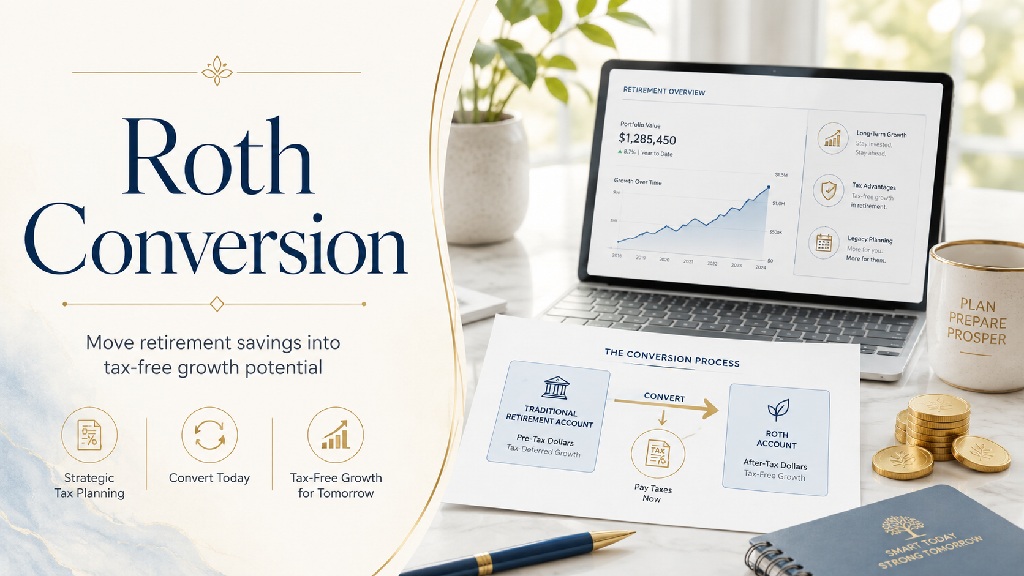
A Roth conversion moves pre-tax retirement money into a Roth IRA and creates taxable income in the year you convert
A Roth conversion takes money that has never been taxed inside a Traditional, SEP, or SIMPLE IRA and moves it into a Roth IRA, and the converted pre-tax amount becomes ordinary taxable income for the year the conversion happens.
The mechanics sit on top of a simple distinction. A Traditional IRA holds pre-tax dollars, meaning contributions were often deductible going in and withdrawals are generally taxable coming out. A Roth IRA works in reverse: contributions are never deductible, but qualified withdrawals come out tax-free. When you convert, you are moving money from the “taxed later” bucket to the “taxed now” bucket, and the Internal Revenue Service is explicit that Roth contributions cannot be deducted, which is the flip side of why a qualified Roth withdrawal owes nothing later. The custodian reports the conversion, and the pre-tax portion you convert is added to your taxable income for that year, taxed at your ordinary income rate rather than at any special conversion rate. If you already hold after-tax (nondeductible) basis in a Traditional IRA, only the pre-tax portion of what you convert is taxable, a distinction that matters most once you understand the pro-rata rule below. This page covers Roth conversions broadly. For the account types themselves, see our guides to the Roth IRA and the Traditional IRA, and start from the IRA education hub if you are still comparing account types generally.
There is no income limit on who can convert to a Roth IRA, even though direct Roth contributions are capped by income
Anyone can convert Traditional, SEP, or SIMPLE IRA money to a Roth IRA regardless of income, because the statute that limits Roth eligibility by income applies only to direct contributions, not to conversions.
This distinction trips up more readers than any other rule on this page. Direct Roth contributions phase out at higher incomes: for 2026, the phase-out range is $153,000 to $168,000 of modified adjusted gross income for single filers and heads of household, and $242,000 to $252,000 for married couples filing jointly. A high earner above those ranges cannot contribute to a Roth IRA directly. But the Internal Revenue Code governs conversions under a separate provision, IRC 408A(d)(3), and the income-limit provision, IRC 408A(c)(3), applies only to the direct-contribution rules. Nothing in the conversion statute imposes an income ceiling. That gap is the entire premise of the “backdoor Roth” strategy: a high earner who cannot contribute directly makes a nondeductible Traditional IRA contribution, then converts it, a workaround that is legal precisely because the conversion rules and the contribution rules are governed by different parts of the statute. See our dedicated backdoor Roth IRA guide for the full strategy, because a clean backdoor conversion depends heavily on the pro-rata rule covered next.
The pro-rata rule taxes a conversion proportionally across all your pre-tax IRA money, even when you only meant to convert after-tax dollars
Under the pro-rata rule, every Traditional, SEP, and SIMPLE IRA you own is treated as one combined account for tax purposes, so a conversion pulls a proportional mix of taxable and nontaxable dollars rather than letting you cherry-pick the after-tax portion.
The rule comes from IRC 408(d)(2), which directs that all of a taxpayer’s individual retirement plans (other than Roth IRAs) are treated as a single contract, and all distributions during the year are treated as one distribution when figuring the taxable amount. In practice, if you hold nondeductible (after-tax) basis in one Traditional IRA but also hold a much larger pre-tax balance in a separate rollover IRA, a conversion cannot isolate the after-tax dollars. The taxable and nontaxable portions of the conversion are calculated across the combined balance of every Traditional, SEP, and SIMPLE IRA you own, so most of a small conversion ends up taxable if pre-tax money dominates the total. Roth IRAs themselves are excluded from that combined pool under IRC 408A(d)(4)(A), and so are balances still sitting inside an employer 401(k) or 403(b) plan, which is why some backdoor Roth strategies deliberately roll pre-tax IRA money into an employer plan first to clear the pro-rata calculation. Nondeductible contributions and conversions are tracked on Form 8606, which the Internal Revenue Service uses to compute the taxable portion of each conversion based on year-end account values across all your Traditional, SEP, and SIMPLE IRAs.
Each Roth conversion starts its own five-year clock, separate from the clock on your regular contributions
Every Roth conversion carries its own individual five-year holding period for penalty purposes, so converting in different years means tracking multiple separate clocks rather than one shared start date.
This is a different five-year rule from the one that governs whether Roth earnings come out tax-free. That earnings clock starts once, with your first Roth contribution of any kind. The conversion clock is separate: under IRC 408A(d)(4), each conversion carries its own five-year period, and if you withdraw the converted (taxable) amount before that specific conversion’s five years are up and before you turn 59 and a half, the 10 percent early-distribution penalty can apply to that converted amount, even though the conversion itself already satisfied income tax. A person who converts in three different years is tracking three separate five-year clocks on those specific converted dollars. Withdrawal ordering also matters here: under IRC 408A(d)(4)(B), distributions from a Roth IRA are treated as coming first from regular contributions, then from conversion amounts on a first-in, first-out basis, and only then from earnings, so contributions can generally be withdrawn without touching the newer conversion money at all.
A Roth conversion is irreversible once it is processed, so there is no undo if the tax bill comes in larger than planned
Once a Roth conversion is completed, current law does not allow it to be reversed, which makes the decision to convert a one-way commitment for that tax year.
Before 2018, taxpayers could “recharacterize” a conversion, effectively undoing it if the market dropped or the tax consequences turned out worse than expected. The Tax Cuts and Jobs Act eliminated that option. Per the Internal Revenue Service, effective January 1, 2018, a conversion from a Traditional, SEP, or SIMPLE IRA to a Roth IRA cannot be recharacterized, and the same law also blocks recharacterizing a rollover to a Roth IRA from an employer plan such as a 401(k) or 403(b). That rule is codified in IRC 408A(d)(6). It is worth distinguishing this from a separate, still-available option: a current-year regular contribution (not a conversion) can still be recharacterized from Traditional to Roth or the reverse, as long as it happens by the filing deadline including extensions. But a conversion itself, once submitted, is final. That is the single biggest reason to think through the tax bill and the timing before converting rather than after.
If you owe a required minimum distribution for the year, that distribution has to come out before any additional amount can be converted
A required minimum distribution for the year is not itself eligible to be converted, so anyone who is already taking required distributions has to satisfy that year’s distribution first and can only convert amounts above it.
The distinction matters because a required minimum distribution and a Roth conversion are both withdrawals from the same account, but only one of them satisfies a legal requirement. The age at which required minimum distributions begin depends on birth year under the SECURE 2.0 Act: age 73 for individuals born between 1951 and 1959, and age 75 for those born in 1960 or later. Roth IRAs carry no lifetime required minimum distribution for the original account owner, which is one reason converting can reduce the total amount of forced, taxable withdrawals later in retirement, even though the conversion itself is fully taxable up front. For the complete rules on distribution timing and amounts, see our required minimum distributions guide.
The best time to convert is usually a year when your income sits in a lower tax bracket than you expect to occupy later, judged qualitatively rather than by a fixed formula
A Roth conversion tends to make the most sense in a year when your taxable income is temporarily lower than your expected future bracket, because the tax you pay on the converted amount is locked in at that year’s rate.
This is a directional judgment, not a calculation with a single right answer, and it depends on income projections nobody can make with certainty. Common lower-income windows include the years between retiring and the start of required minimum distributions, a year with a business loss, or a sabbatical or reduced-income year before Social Security or a pension begins. Converting in a year like that means paying tax on the converted amount at a lower rate than you might otherwise face later, particularly if required minimum distributions or other income sources would push you into a higher bracket in the future. The comparison runs the other way too: converting in a high-income year adds the converted amount on top of income that is already taxed at a higher rate, which can be the more expensive choice. None of this should be modeled with invented dollar figures. It is a framework for the conversation to have with your own tax professional, informed by your actual income history and projections, not a number this page can supply. Our tax strategy guide and retirement calculator walk through the planning inputs in more detail, and IRA investing by life stage covers how the conversion decision tends to shift as retirement approaches.
Frequently Asked Questions
Is a Roth conversion the same thing as a Roth contribution? No. A contribution adds new money to a Roth IRA and is subject to annual dollar limits and income phase-outs. A conversion moves existing money that is already inside a Traditional, SEP, or SIMPLE IRA into a Roth IRA and is governed by a separate set of rules, including the fact that it has no income limit.
How much tax will I owe on a Roth conversion? The pre-tax portion of whatever you convert is added to your taxable income for that year and taxed at your ordinary income rate. If you hold any after-tax basis across your Traditional, SEP, and SIMPLE IRAs, the pro-rata rule determines what portion of the conversion counts as taxable versus a tax-free return of basis. This page does not model a specific dollar figure, since your rate depends on your full tax picture.
Can I convert only part of a Traditional IRA instead of the whole balance? Yes. A partial conversion is common and is one of the main tools used to manage the size of the tax bill in a given year, since the converted amount is added to that year’s taxable income.
Do I need earned income to do a Roth conversion? No. Earned income is a requirement for making a new Roth contribution, not for converting existing IRA money. A conversion is a movement of already-existing funds, so the earned-income test that applies to contributions does not apply here.
What is the backdoor Roth strategy, and is it legal? The backdoor Roth is a two-step approach where a taxpayer who earns too much to contribute to a Roth IRA directly instead makes a nondeductible contribution to a Traditional IRA and then converts it. It is legal because the conversion rules under IRC 408A(d)(3) carry no income limit, even though the direct-contribution rules do. The pro-rata rule is the main complication, since it applies to the conversion step regardless of intent. See our backdoor Roth IRA guide for the full mechanics.
Can I reverse a Roth conversion once I have made it? No. Recharacterization of a conversion was eliminated by the Tax Cuts and Jobs Act for conversions made on or after January 1, 2018. Once processed, a conversion is final for that tax year.
Does converting to a Roth IRA trigger the 10 percent early withdrawal penalty? The conversion itself does not trigger the penalty. The penalty can apply later if you withdraw the converted amount before its own five-year clock is up and before you turn 59 and a half. Each conversion has a separate five-year clock for this purpose.
Can I convert my required minimum distribution to a Roth IRA? No. An amount that qualifies as your required minimum distribution for the year has to be taken as a distribution first. Only amounts above that required distribution are eligible to be converted.
Roth conversions involve a real, immediate tax bill in exchange for a potential future benefit, and the right answer depends on your income, your account balances, and your timeline in a way no general guide can calculate for you. Always consult your own legal, financial, and tax professionals before deciding whether, when, or how much to convert.
By Tim Schmidt + Sean Webster Reviewed by Sean Webster