
Types of IRA Accounts: Which One Is Right for You?
TL;DR: The main types of IRA accounts are the Traditional IRA and the Roth IRA for individuals, the SEP IRA and SIMPLE IRA for the self-employed and small employers, and two special-purpose variants, the Spousal IRA and the custodial (minor) Roth IRA. For 2026 the combined Traditional-plus-Roth contribution limit is $7,500, or $8,600 with the age-50 catch-up, while the SEP cap runs up to $72,000 and the standard SIMPLE deferral is $17,000. The right account depends on whether income is earned through a job or self-employment, whether a tax break is wanted now or in retirement, and whether an employer is involved at all.
What Are the Main Types of IRA Accounts?
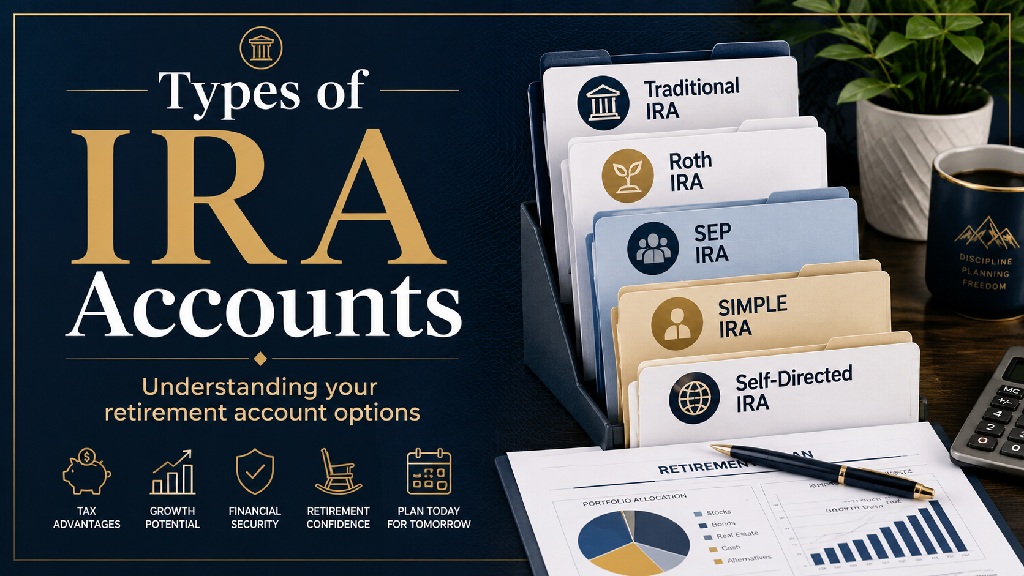
Most savers are choosing between a Traditional IRA and a Roth IRA, while the self-employed and small-business owners have two additional employer-style options in the SEP IRA and the SIMPLE IRA.
An individual retirement arrangement, or IRA, is a tax-advantaged account opened directly with a custodian rather than through an employer’s payroll system. The Internal Revenue Service recognizes several distinct IRA structures, and each one is built for a different combination of income source, tax preference, and household situation. The table below gives the 2026 shape of each account before the sections that follow walk through who each one actually fits.
| Account type | Who it fits | 2026 contribution limit | Tax treatment |
| Traditional IRA | Anyone with taxable compensation | $7,500 ($8,600 age 50+) | Contributions may be deductible, growth is tax-deferred, withdrawals are taxed as income |
| Roth IRA | Savers under the MAGI phase-out thresholds | $7,500 ($8,600 age 50+) | Contributions are never deductible, qualified withdrawals are tax-free |
| SEP IRA | Self-employed individuals and small-business owners | Lesser of 25% of compensation or $72,000 | Employer-only contribution, tax-deferred growth |
| SIMPLE IRA | Employers with up to 100 employees | $17,000 deferral, $4,000 catch-up at age 50+ | Employee deferral plus a required employer contribution, tax-deferred |
| Spousal IRA | A non-earning or lower-earning spouse on a joint return | $7,500 ($8,600 age 50+), same as Traditional or Roth | Follows whichever underlying account, Traditional or Roth, is opened |
| Custodial (minor) Roth IRA | A minor with earned income | Lesser of earned income or $7,500 | Roth tax treatment, managed by an adult custodian |
Traditional IRA: Who It Fits and How the Tax Break Works
A Traditional IRA suits anyone with taxable compensation who wants a possible upfront deduction and is comfortable paying tax on withdrawals later.
For 2026 the contribution limit is $7,500, rising to $8,600 with the $1,100 age-50 catch-up, and the total can never exceed the saver’s taxable compensation for the year. Contributions may be tax-deductible, but the deduction phases out by income only if the saver, or their spouse, is covered by a workplace retirement plan. For 2026 that phase-out runs from $81,000 to $91,000 for a single filer or head of household who is covered, from $129,000 to $149,000 for a covered spouse filing jointly, and from $242,000 to $252,000 for a filer who is not covered but whose spouse is. If neither spouse is covered by a workplace plan, the full deduction applies regardless of income. Growth inside the account is tax-deferred, withdrawals are generally taxed as ordinary income, and the account owner must begin required minimum distributions at age 73. The full mechanics, including the deduction math by filing status, are covered on the site’s dedicated Traditional IRA page.
Roth IRA: Who It Fits and How Tax-Free Growth Works
A Roth IRA suits a saver under the income limits who would rather pay tax now and take withdrawals tax-free in retirement.
The 2026 contribution limit is the same $7,500, or $8,600 with the catch-up, but Roth contributions are never tax-deductible. In exchange, qualified distributions, generally those taken after the account has been open five years and the owner has reached age 59 and a half, are not included in taxable income at all. Eligibility is capped by modified adjusted gross income: for 2026 the phase-out runs from $153,000 to $168,000 for single filers and heads of household, and from $242,000 to $252,000 for married couples filing jointly. Unlike a Traditional IRA, a Roth IRA carries no lifetime required minimum distribution for the original owner, which is one reason it is often used for legacy planning as well as retirement income. The full rules, including the five-year clock and the ordering rules for early withdrawals, live on the Roth IRA page.
SEP IRA: The Self-Employed and Small-Business Option
A SEP IRA lets a self-employed person or small-business owner make a large, employer-only contribution with none of the payroll complexity of a 401(k).
Any employer, including a sole proprietor with no other employees, can establish one. For 2026 the contribution cannot exceed the lesser of 25% of compensation or $72,000, calculated against a compensation cap of $360,000. Because SEP contributions are employer contributions only, there is no employee salary-deferral option and no age-50 catch-up. An employee must generally have reached age 21, worked for the employer in at least three of the last five years, and received at least $800 in compensation for 2026 to be eligible, though an employer may set less restrictive rules. Every eligible employee, including the owner, must receive the same contribution rate. Details on the 25% calculation and eligibility rules are on the SEP IRA page.
SIMPLE IRA: For Small Employers With Up to 100 Employees
A SIMPLE IRA fits a small employer, including a self-employed individual, who wants employees to defer their own salary while the employer also contributes.
An employer with more than 100 employees who each earned at least $5,000 in the prior year is not eligible to adopt one. Employees who earned at least $5,000 in any two prior years and expect to earn $5,000 in the current year are generally eligible to participate. For 2026 the standard employee deferral is capped at $17,000, with certain small employers permitted to allow up to $18,100, and the age-50 catch-up is $4,000, rising to $5,250 for savers ages 60 through 63. The employer must either match employee deferrals dollar-for-dollar up to 3% of compensation, or make a flat 2% nonelective contribution for every eligible employee regardless of whether that employee defers. More detail on the match formulas is on the SIMPLE IRA page.
Spousal IRA: Contributing on a Non-Working Spouse’s Behalf
A Spousal IRA is not a separate account type but a rule that lets a couple filing jointly fund an IRA for a spouse with little or no income of their own.
Under the Kay Bailey Hutchison Spousal IRA provision, a couple filing a joint return may contribute to an IRA for a non-earning or lower-earning spouse based on the working spouse’s compensation, up to the same annual limit, $7,500 for 2026 or $8,600 with the catch-up, that applies to any individual account. The account can be structured as either a Traditional or a Roth IRA, and it follows that underlying account’s tax treatment. This is one of the more overlooked options for households where one spouse has stepped away from paid work, since it lets both spouses keep building retirement savings even when only one has taxable compensation.
Custodial (Minor) Roth IRA: Opening an IRA for a Minor
A custodial Roth IRA lets a minor with their own earned income start tax-advantaged retirement savings decades ahead of a typical first job.
The account requires the minor to have taxable compensation, such as wages from a part-time job, and the contribution is limited to the lesser of that earned income or the standard annual limit, $7,500 for 2026. Passive income, such as gifts, allowances, interest, or dividends, does not count toward eligibility. An adult custodian opens and manages the account on the minor’s behalf, and control transfers once the minor reaches the age of majority under the custodial account law of their state. The tax treatment otherwise follows standard Roth rules: no deduction going in, and qualified withdrawals in retirement come out tax-free.
Solo 401(k): A Self-Employed Alternative Worth Knowing
A self-employed person with no employees other than a spouse can often save far more through a Solo 401(k) than through any IRA.
A Solo, or one-participant, 401(k) is available to a business owner with no common-law employees, and it lets that owner contribute in two capacities at once, as employee and as employer. For 2026 the combined total can reach $72,000, or $80,000 with the age-50 catch-up, and up to $83,250 for savers ages 60 through 63. That capacity is well beyond any IRA and typically beyond a SEP IRA as well, since a SEP is funded by the employer share alone with no employee deferral. This page stays focused on IRA accounts, but a self-employed reader comparing options should see the dedicated Solo 401(k) page before deciding between the two structures.
Which IRA Is Right for You?
The choice generally comes down to three questions: is the income from a job or self-employment, is a tax break wanted now or later, and is an employer or spouse involved in the picture.
A saver with straightforward W-2 income who wants flexibility on the deduction chooses between a Traditional and a Roth IRA based on current versus expected future tax brackets. A self-employed saver who wants to shelter a large share of business income looks at a SEP IRA or a Solo 401(k). A small-business owner who wants employees to save through payroll deferral looks at a SIMPLE IRA. A household with one non-earning spouse can still fund a second account through the Spousal IRA rule, and a parent whose teenager has a part-time job can start that teenager’s retirement savings decades early through a custodial Roth IRA. Because contribution limits, deduction rules, and phase-outs change with tax law and household circumstances, it is worth confirming current figures on the site’s IRA contribution limits page, walking through the mechanics on how to open an IRA, and modeling the long-term difference using a retirement calculator before committing to a specific account type. Readers weighing an account against their own timeline can also see how the right choice tends to shift by decade on the IRA investing by life stage page, and savers considering a broader range of asset classes inside an IRA wrapper can review the self-directed IRA structure. Always consult your own legal, financial, and tax professionals before opening or changing a retirement account.
Frequently Asked Questions
What are the different types of IRA accounts? The core types are the Traditional IRA and the Roth IRA, which any individual with taxable compensation can open, plus the SEP IRA and SIMPLE IRA, which are funded through an employer or self-employment. The Spousal IRA and the custodial Roth IRA are variations on the Traditional and Roth structures rather than separate account types.
Which IRA is right for me? It depends on how the income is earned and whether the tax break is more valuable now or in retirement. A Traditional IRA can offer a deduction today if eligible, a Roth IRA offers tax-free withdrawals later, and the SEP or SIMPLE IRA (or a Solo 401(k)) generally fits a self-employed saver or small-business owner better than an individual account alone.
Can I have more than one type of IRA? Yes. A saver can hold a Traditional IRA and a Roth IRA at the same time, but the combined contributions across both cannot exceed the single annual limit, $7,500 for 2026 or $8,600 with the age-50 catch-up.
What is the difference between a Traditional IRA and a Roth IRA? A Traditional IRA contribution may be deductible today, with withdrawals taxed as income later. A Roth IRA contribution is never deductible, but qualified withdrawals in retirement are tax-free. Both share the same 2026 contribution limit.
Can a self-employed person open more than one type of retirement account? Yes. A self-employed individual can compare a SEP IRA against a Solo 401(k), and either can generally be paired with a personal Traditional or Roth IRA, subject to each account’s own limits and, for the Traditional IRA deduction, the applicable income phase-out.
Always consult your own legal, financial, and tax professionals before opening or changing a retirement account.
By Tim Schmidt + Sean Webster Reviewed by Sean Webster