
IRA Investing by Life Stage 2026: A Decade-by-Decade Strategy
TL;DR: Your IRA strategy should change as you age. The 2026 contribution ceiling is 7,500 dollars (the base limit for the year), with a 1,100 dollar catch-up at 50 and an 11,250 dollar super catch-up for ages 60 to 63 (the widest savings window in the code). Required minimum distributions start at 73. I scale gold from 5 to 20 percent (the standard allocation band) as the horizon shortens.
Disclosure: Companies featured here may provide compensation for click throughs. This is how I maintain free research for consumers. My full disclosure of who I invested with is on this page for transparency.
Disclaimer: This article is educational and is not financial, tax, or legal advice. Consult a qualified professional before any retirement-account decision.
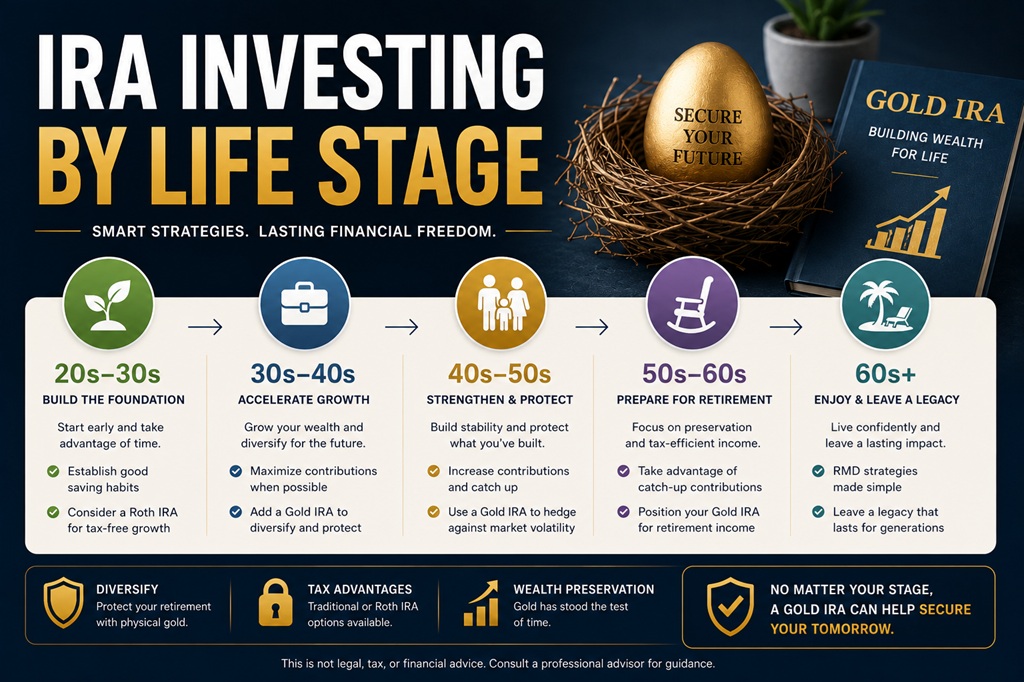
How Should Your IRA Strategy Shift as You Move Through Each Decade?
The strategy shifts because two things change with age: how much you’re allowed to contribute and how much risk your horizon can absorb. A 35-year-old and a 68-year-old can both own gold inside an IRA, but the right contribution level, the right allocation, and the right tax treatment look nothing alike.
I’ve been running this site since 2012, and the question I field most often is some version of what a reader should be doing right now, at their age. The honest answer is that there’s a different playbook for each phase. The accumulation years are about funding and growth. The fifties are about catch-up contributions. Ages 60 to 63 (a four-year window) are the single richest savings stretch in the tax code. The years before 73 are a planning window. After 73, the IRS starts requiring withdrawals.
Gold runs through all of it as a portfolio anchor. The World Gold Council reports that gold has outpaced the United States and world consumer price indices since 1971 (the start of the modern floating-rate era), and that in years when inflation ran between 2 percent and 5 percent (a moderate-inflation band), the price of the metal increased 10 percent per year on average. That inflation-hedge behavior matters more the closer you get to drawing the account down.
What stays constant is the structure. Every phase uses the same self-directed IRA wrapper, the same custodian, and the same eligible-product list. What changes is the dial settings, the contribution ceiling, and the share of the account I want anchored in metal. You can read the next five sections as five settings on the same machine. So where do you start?
What Should You Do in the Accumulation Years (Ages 30 to 49)?
In the accumulation years, max the contribution and tilt toward growth. For 2026 the Traditional and Roth IRA contribution limit is 7,500 dollars, up from 7,000 dollars (the 2025 figure), under IRS Notice 2025-67. There’s no catch-up yet, so 7,500 dollars (the ceiling for under-50 savers) is the cap, and the priority is funding consistently over decades rather than fine-tuning the allocation.
The Roth-versus-Traditional decision is the live one in this phase. Younger savers in lower brackets often favor the Roth because they pay tax now and withdraw tax-free later. The 2026 Roth contribution phase-out runs from 153,000 dollars to 168,000 dollars (for single filers) of modified adjusted gross income, and from 242,000 dollars to 252,000 dollars (for married couples filing jointly). If your income clears those ranges, the Traditional deduction has its own phase-out, which for a single filer covered by a workplace plan runs 81,000 dollars to 91,000 dollars (the covered-single band) and for a married couple filing jointly runs 129,000 dollars to 149,000 dollars (the covered-joint band).
The reason this decade carries the heaviest lifting is compounding. A dollar contributed at 35 has thirty years to grow before the account is drawn down, and the tax-free Roth wrapper turns that runway into the single largest lever a young saver controls. What matters more than picking the perfect split is funding the account every single year.
Should a 35-year-old hold any gold at all? My view is yes, but at the low end. A 5 to 10 percent allocation (the entry-level weight) to physical metal is the starting position for a saver early in the accumulation phase. The diversification benefit is real and the drag on equity-based growth is minimal at that weight.
The metal you choose still has to be IRA-eligible. The bullion qualifies under IRC Section 408(m)(3) when it meets a minimum fineness and sits in the physical possession of a qualifying trustee. The gold floor is 0.995 (a 99.5 percent purity standard). The mechanics of the self-directed IRA are worth learning early, because the habits you build at 35 compound for thirty years.
How Do Catch-Up Contributions Change the Plan at Age 50?
At 50, the contribution ceiling jumps and the allocation starts to climb. The 2026 IRA catch-up for savers age 50 and older is 1,100 dollars, up from 1,000 dollars (the 2025 catch-up), which lifts the total allowable IRA contribution to 8,600 dollars (the combined 50-plus figure). If you also fund a workplace plan, the 401(k) elective deferral limit is 24,500 dollars (the 2026 base deferral), with a standard catch-up of 8,000 dollars (for savers 50 and up) on top.
That’s a meaningful step up. A married couple both over 50 can each contribute 8,600 dollars (the full 50-plus IRA amount) in the same year, before touching workplace plans. The fifties are usually peak earning years, and the tax code rewards that by widening the funnel right when you have the cash flow to use it.
The allocation shifts too. I move the gold weight to the 10 to 15 percent range (the mid-career band) for most serious retirement savers in this decade. The horizon is still long enough to ride out volatility, but it’s short enough that the inflation-hedge and non-correlation benefits start to earn their place.
This is also the decade to consolidate scattered accounts. If you’ve changed jobs a few times, you may have old 401(k) balances sitting in former-employer plans. Rolling those into a single IRA simplifies the picture and opens the door to a gold allocation the workplace plan never offered. The gold IRA rollover process is the mechanism, and the rules around it tighten the closer you get to retirement. Why leave money stranded in a plan you no longer control?
Why Do Ages 60 to 63 Matter More Than Any Other Savings Window?
Ages 60 to 63 matter because of the super catch-up, the single most generous contribution window in the retirement-savings code. Under the SECURE 2.0 Act, a higher catch-up of 11,250 dollars (for that four-year span only) applies to 401(k) participants who are ages 60, 61, 62, and 63 during the year, replacing the standard 8,000 dollar catch-up.
Stack that on the base deferral and the numbers get serious. A 61-year-old can defer 24,500 dollars (the base deferral) plus the 11,250 dollar super catch-up into a workplace plan, then add the 8,600 dollar IRA contribution on top. For two earners in the same window, the combined annual tax-advantaged contribution reaches well into six figures. This is the last sprint before the finish line, and the code is built to let you run it hard.
The allocation reaches its widest point here. I take gold to the 15 to 20 percent range (the pre-retirement band) for investors closer to or already entering retirement, and for anyone carrying concentrated equity positions who wants a documented crisis hedge. This is the stabilization decade, and it’s exactly the use case I hear most from readers nearing the end of their careers. The stabilization motive, according to Tim Schmidt, summarizing the pre-retirement pattern on a recent operator call, is what drives most readers to the metal in this decade.
A lot of people do this when they’re nearing retirement as a way to stabilize their portfolio because if people are retiring in 10 or 15 years and the market goes through big turbulence, an economic meltdown, a COVID pandemic style meltdown, and they need to retire then, that is a serious detriment to their whole portfolio.
Tim Schmidt Sr., May 2026 (operator call)
The reason the metal earns the higher weight now is sequence risk. A market drop in your early sixties does far more damage than the same drop at 40, because you don’t have the runway to recover before you start drawing the account down.
How Should You Handle the Early Retirement Years Before RMDs (Ages 64 to 72)?
The years from 64 to 72 are a planning window, because you’re likely retired but not yet forced to take distributions. Required minimum distributions don’t begin until 73 (the SECURE 2.0 trigger age), which leaves a stretch where your taxable income may be lower than it’s ever been and the account is fully under your control.
That gap is the Roth-conversion window. A conversion in low-income years moves money from a Traditional account into a Roth, lets you pay tax at a reduced rate now, and removes those dollars from future required distributions entirely. There’s no income limit on conversions and no annual cap, so this is a planning lever rather than a contribution lever.
Spreading conversions across several low-income years is the disciplined way to use the window. Convert too much in one year and you can push yourself into a higher bracket or trigger higher Medicare premiums. Convert a measured slice each year and you fill up the lower brackets without spilling into the next one. This is the kind of multi-year tax planning a CPA earns their fee on.
Rollover mechanics deserve real care in this phase. Per IRS guidance following Announcement 2014-15, you may make only one IRA-to-IRA rollover in any 12-month period (regardless of how many IRAs you own). A trustee-to-trustee transfer is not a rollover and isn’t subject to that limit, and there’s no statutory cap on the number of transfers. When you reposition metal or cash between custodians, use the direct transfer and you sidestep the once-a-year trap.
Is gold still worth holding once the paychecks stop? It is, and arguably more so. The metal posted its strongest annual performance since 1979 in 2025, gaining 60.6 percent (per the LBMA Gold Price PM benchmark) on the year, according to World Gold Council data. I hold the allocation steady in the 15 to 20 percent band (the same pre-retirement weight) through this window and let the conversions do the heavy lifting on the tax side.
What Changes When Required Minimum Distributions Begin at Age 73?
At 73 the account stops being optional to draw down. Under Section 107 of the SECURE 2.0 Act, the required minimum distribution age is 73 for individuals who reach 72 after December 31 of 2022, and rises to 75 for those who reach 74 after December 31 of 2032. An individual born in 1959 (a common edge case) uses age 73 per IRS guidance.
The math is mechanical. You divide the prior year-end balance by the divisor from the IRS Uniform Lifetime Table in Publication 590-B. The divisor is 26.5 years (at age 73), 25.5 years (at age 74), and 24.6 years (at age 75), and it shrinks each year, so the required percentage rises as you age. Miss a distribution and the cost is steep. The excise tax under IRC Section 4974 runs 25 percent (of the shortfall), dropping to 10 percent (if you correct it within the two-year window).
Gold inside the IRA can satisfy an RMD in one of two ways. You sell enough metal to raise the cash, or you take an in-kind distribution and have the physical coins or bars shipped to you, with the fair market value reported as the distribution. The metal leaves the tax shelter either way, but the in-kind route keeps you holding the actual asset. You should plan the sale or the shipment well before the December 31 deadline, because depository processing and dealer settlement both take time.
Charitably inclined retirees have a third option. A qualified charitable distribution lets an owner age 70 and a half or older send up to 111,000 dollars (the 2026 QCD limit) directly to a qualifying charity, up from 108,000 dollars (the 2025 figure), and that amount counts toward the RMD without entering taxable income. Do you have to drain the whole account at 73? No. You only have to take the required slice, and the rest keeps compounding.
Which Gold IRA Operator Fits Your Life Stage and Account Size?
The right operator is mostly a function of your rollover size, and the funnel I recommend on this site sorts cleanly by minimum. Augusta Precious Metals leads it for accounts of 50,000 dollars and up, Goldco covers the 25,000 dollar tier, Noble Gold serves the 20,000 dollar tier, and American Hartford Gold opens the entry tier at 10,000 dollars (the lowest minimum in the set).
Augusta is the top pick where the educational depth pays back. It requires a minimum investment of 50,000 dollars (its account floor) and charges a one-time 50 dollar setup fee plus annual fees of around 225 dollars, made up of 125 dollars (for the custodian) and 100 dollars (for storage), with no management fees. The differentiator is the one-on-one education, and it’s the reason I send so many readers there. The web-conference walkthrough, according to Tim Schmidt, summarizing his own referral experience on a recent operator call, is what sets Augusta apart from the rest of the funnel.
You get a one-on-one web conference with a Harvard-educated man who takes you through the process, Devlin Steele. They have an impeccable record online with BBB. I’ve sent a lot of people there to do business and they’ve been very happy.
Tim Schmidt Sr., May 2026 (operator call)
For the mid-tiers, Goldco’s required minimum is 25,000 dollars, with a 50 dollar setup fee, a 30 dollar wire fee, 100 dollars (for annual maintenance), and storage of 150 dollars (segregated) or 100 dollars (non-segregated). Per Money.com’s 2026 benchmarking, American Hartford Gold opens at a 10,000 dollar minimum with an annual IRA fee of 75 dollars (for accounts of 100,000 dollars or less) and 125 dollars above that, and Noble Gold charges an 80 dollar account fee plus 150 dollars (for insurance and segregated storage). The full lineup lives on the gold IRA companies page. Match the operator to the balance you’re actually rolling over, not to the flashiest ad.
How Does the Gold Allocation Framework Hold Across Every Life Stage?
The framework holds because the 5 to 20 percent band (the full allocation range) scales smoothly with age while the underlying structure never moves. Younger savers anchor near 5 to 10 percent (the entry band), mid-career savers at 10 to 15 percent (the middle band), and pre-retirees and retirees at 15 to 20 percent (the top band). The number tracks your horizon, not the headlines.
The structure beneath the allocation is fixed by statute. An IRS-approved custodian holds the account, an IRS-approved depository stores the metal, and the eligible-product list flows from IRC Section 408(m)(3). Eligible gold meets a 0.995 fineness floor (the 99.5 percent standard), with one statutory exception. The American Gold Eagle from the U.S. Mint is eligible at 91.67 percent (its statutory purity) because the statute enumerates it directly. The carve-out excludes numismatic and collectible coins, and that distinction is the one I wish more first-time buyers understood. The product type, according to Tim Schmidt, summarizing the bullion-versus-collectibles rule on a recent operator call, is the whole game.
Bullion is gonna be where they want to go. Just like the main thing is it’s either IRA approved coin or bar. Not a collectible. That’s the main takeaway.
Tim Schmidt Sr., May 2026 (operator call)
One rule overrides every life stage: you can’t store the metal at home. In McNulty v. Commissioner, 157 T.C. No. 10, decided in November of 2021, the United States Tax Court held that the owner of a self-directed IRA may not take actual and unfettered possession of the IRA assets. The court determined deficiencies of 250,558 dollars (for tax year 2015) and 18,094 dollars (for tax year 2016) against a couple who kept IRA coins at their home. Any operator promising a home-storage gold IRA is steering you straight into that ruling.
Frequently Asked Questions
What is the IRA contribution limit for 2026?
The 2026 Traditional and Roth IRA contribution limit is 7,500 dollars, up from 7,000 dollars in 2025, under IRS Notice 2025-67. Savers age 50 and older can add a catch-up contribution of 1,100 dollars, bringing their total allowable IRA contribution to 8,600 dollars for the year. These limits apply across all of an individual’s IRAs combined, not per account.
What is the super catch-up contribution for ages 60 to 63?
The super catch-up is a higher 401(k) catch-up of 11,250 dollars that applies only to participants who are ages 60, 61, 62, and 63 during the year, under the SECURE 2.0 Act. It replaces the standard 8,000 dollar catch-up for that four-year window. Once a saver turns 64, the catch-up reverts to the standard amount, so the larger figure is a limited-time window.
At what age do required minimum distributions start?
Required minimum distributions start at age 73 for individuals who reach age 72 after December 31 of 2022, under Section 107 of the SECURE 2.0 Act. The age rises to 75 for individuals who reach age 74 after December 31 of 2032. Missing a required distribution triggers an excise tax of 25 percent of the shortfall, reduced to 10 percent if corrected within two years.
How much of my IRA should be in gold?
A common framework places 5 to 20 percent of a retirement portfolio in physical precious metals, scaled by time horizon. Younger savers anchor near 5 to 10 percent, while pre-retirees and retirees move toward 15 to 20 percent for inflation protection and crisis hedging. The right number depends on your existing portfolio and how close you are to drawing the account down.
Can I store my gold IRA metals at home?
No. The United States Tax Court held in McNulty v. Commissioner that an IRA owner may not take actual and unfettered possession of IRA assets, and home storage triggered tax deficiencies of 250,558 dollars and 18,094 dollars against the taxpayers. IRA metals must be held by an IRS-approved depository through a qualifying custodian. Any company offering a home-storage gold IRA is a clear warning sign.
Risk Warning: Precious-metals prices can be volatile. Gold and silver IRAs are subject to IRS rules, custodian fees, and storage costs that affect net returns. Past performance does not predict future results. This article is educational only and is not investment, tax, or legal advice. Consult a qualified professional before any retirement-account decision.
To start, request the free Augusta Precious Metals information kit and read the operator-attested fee schedule and the IRA-eligible product list before any phone contact.
About the Author
Tim Schmidt Sr. has been covering precious-metals investing since 2012. He founded IRAInvesting.com that year and has spent more than a decade evaluating gold IRA companies, custodians, and depositories firsthand as a personal account holder. He serves as VP Business Development at Cayman Financial Review and operates Ice Cold Marketing from Weston, Florida. His commentary has appeared in Yahoo Finance, USA Today, Business Insider, Tech Times, and CNBC.
Reviewed by Sean Webster, CPA
Sean Webster is a Certified Public Accountant who reviewed this article for accuracy on the tax, contribution-limit, and required-minimum-distribution figures cited throughout.